
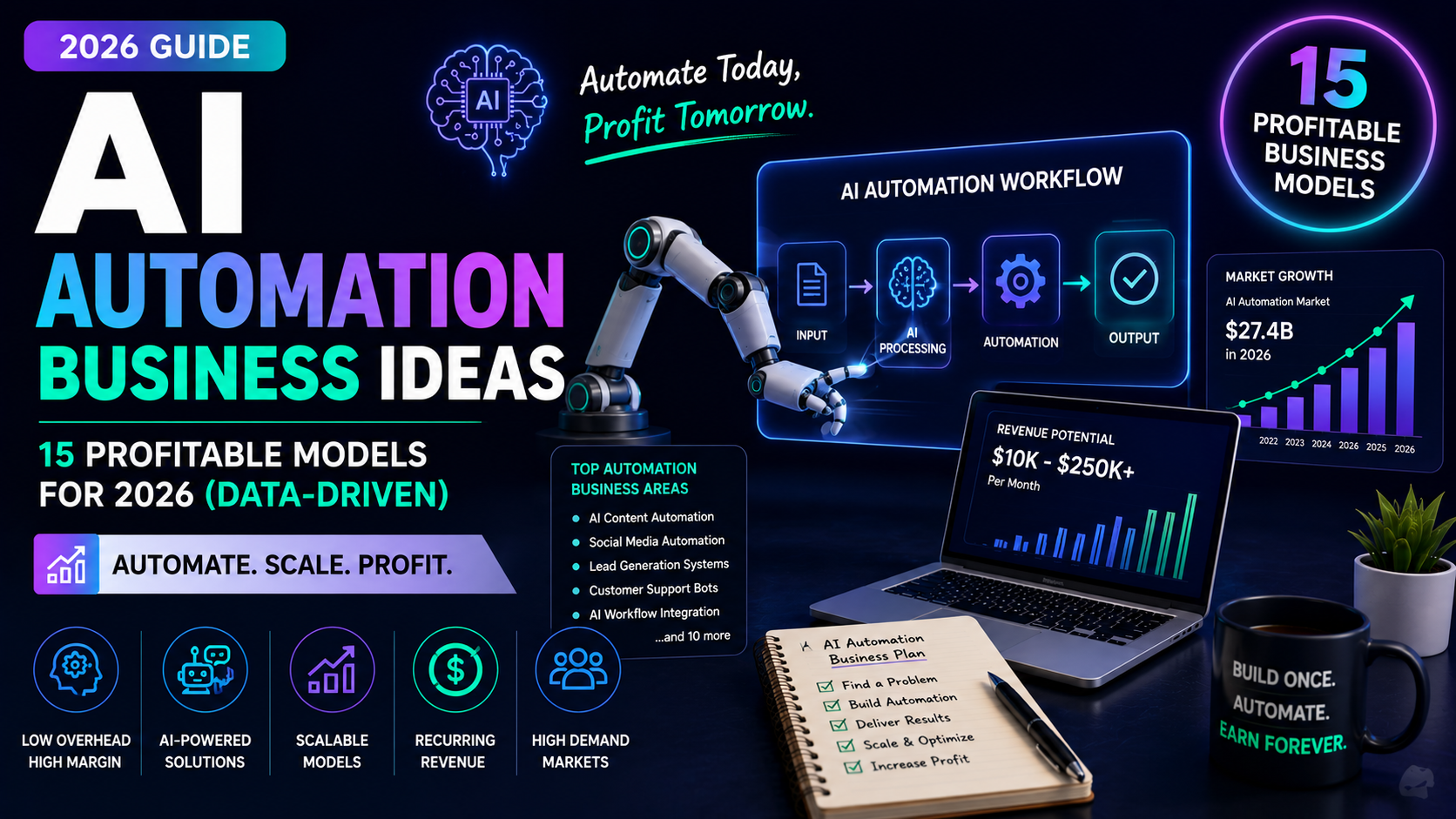
AI Automation Business Ideas for 2026
Discover 15 proven AI automation business ideas for 2026. Real pricing, niche breakdown, ROI data, and a step-by-step launch plan. No coding required.
Related tools for this topic
Use our free AI tools to apply what you just read. No signup required.
AI Automation Business Ideas: 15 Profitable Models for 2026 (Data-Driven)
Quick Answer
An AI automation agency is a business that builds and deploys AI-powered workflows for other companies, replacing manual, repetitive processes with systems that run automatically using tools like Make, Zapier, n8n, and large language model APIs. The 15 most profitable AI automation business models in 2026 are: lead follow-up automation, invoice and billing automation, customer support chatbots, social media management automation, email marketing automation, data entry and processing, appointment scheduling, content repurposing, report generation, compliance monitoring, recruitment screening, inventory management, pricing optimization, review response automation, and personalized outreach sequences. Startup costs range from $0-$500, and monthly retainers typically run $500-$5,000 per client.
Start your automation business: Generate your specific niche with our AI Startup Idea Generator.
What Is an AI Automation Business?
An AI automation business builds intelligent systems that handle repetitive tasks for other companies. Instead of selling a one-time service, you sell a system that runs continuously, creating predictable monthly recurring revenue.
Core model:- Identify a repetitive task that costs a business time or money
- Build an AI-powered automation that handles the task automatically
- Charge a monthly fee for the automation to run and maintain it
- Scale by adding more automations or more clients
- High perceived value: Businesses pay for outcomes (hours saved, errors reduced), not effort
- Recurring revenue: Monthly retainers create predictable income
- Scalability: One automation system can serve hundreds of clients with minimal extra work
- Low marginal cost: Once built, each additional client costs almost nothing to serve
- Sticky clients: Once a business relies on your automation, switching costs are high
The key distinction: You are not selling AI tools. You are selling the business outcome of those tools. A business does not care about your Zapier workflow. They care that leads are followed up within 5 minutes instead of 48 hours.
Why AI Automation Businesses Are Exploding in 2026
| Statistic | Value | Source | |
|---|---|---|---|
| Business process automation market, 2026 forecast | $19.6 billion | MarketsandMarkets | |
| US firms using AI | 19.8% | US Census Bureau, BTOS 2026 | |
| Small businesses that have invested in AI | 57% | Business.com, 2026 SMB AI Outlook | |
| Firms using workflow automation tools | 19% | Business.com, 2026 SMB AI Outlook | |
| Average time saved per week with AI tools | 5.6 hours | Business.com, 2026 SMB AI Outlook | |
| Return on marketing automation spend | $5.44 per $1 over three years | Nucleus Research | |
| Automation specialist hourly rate on Upwork | $40 to $100 | Upwork hiring guides |
- Labor shortage: Businesses cannot hire enough staff for repetitive tasks. A restaurant that needs 24/7 reservation handling cannot hire a human for 3 AM calls. An AI chatbot can.
- Margin pressure: Inflation and competition squeeze business margins. Automations that cut costs by 20-30% are immediate wins for business owners.
- AI democratization: No-code platforms (Zapier, Make, n8n) and AI APIs (OpenAI, Anthropic) make automation building accessible to non-coders. The barrier to entry has dropped from "hire a developer" to "learn a no-code tool." For more advanced use cases, see real autonomous AI agent examples by industry to understand what is already being deployed at scale.
AI Automation vs Traditional Consulting
| Factor | AI Automation Business | Traditional Consulting | |
|---|---|---|---|
| Revenue Model | Monthly recurring (retainers) | One-time or hourly | |
| Income Predictability | High (contracts renew) | Low (feast or famine) | |
| Scalability | High (systems serve many) | Low (time-constrained) | |
| Client Acquisition | One sale = years of revenue | One sale = one project | |
| Value Proposition | "Save time forever" | "Solve this problem once" | |
| Pricing Power | $500-$5,000/month | $1,000-$10,000/project | |
| Barrier to Entry | Low (no-code tools) | High (industry expertise) | |
| Exit Potential | Sell the business/agency | Hard to sell (personal brand) |
The 15 Most Profitable AI Automation Business Models in 2026
1. Lead Follow-Up Automation
What it does: Automatically follows up with leads via email, SMS, and voicemail within minutes of inquiry, nurturing them until they book a call or purchase. Target clients: Real estate agents, coaches, SaaS companies, local service businesses Why it sells: 78% of leads buy from the first company that responds. Most businesses respond in 24-48 hours. An automation that responds in 5 minutes captures the lead before competitors even see it. Pricing: $1,000-$3,000 setup + $300-$800/month Tools: Zapier, GoHighLevel, Make, ActiveCampaign, Twilio Example: A real estate agent gets 40 leads per week. The automation sends a personalized email in 2 minutes, an SMS in 10 minutes, and a voicemail in 30 minutes. The agent's conversion rate jumps from 3% to 12%, adding 3.6 extra deals per month at $8,000 average commission. The agent happily pays $600/month for the automation.2. Invoice and Billing Automation
What it does: Automatically generates invoices, sends payment reminders, reconciles payments, and flags overdue accounts. Target clients: Freelancers, agencies, consultants, small service businesses Why it sells: Late payments kill cash flow. 60% of small businesses report late payments as a major problem. Automation reduces payment delays from 45 days to 15 days on average. Pricing: $500-$1,500 setup + $200-$500/month Tools: QuickBooks, Stripe, Zapier, Make, PandaDoc Example: A marketing agency with 30 clients spends 12 hours per month on invoicing. The automation cuts this to 30 minutes and reduces late payments by 40%. The agency saves $2,400/month in labor and recovered cash flow. They pay $400/month for the automation.3. Customer Support Chatbots
What it does: Handles 80% of customer inquiries automatically, escalating only complex issues to human agents. Target clients: E-commerce stores, SaaS companies, healthcare clinics, restaurants Why it sells: Support tickets cost $15-$50 per interaction when handled by humans. Chatbots handle them at $0.10-$0.50 per interaction. A business with 500 tickets/month saves $7,000-$24,000 monthly. Pricing: $1,500-$5,000 setup + $300-$1,000/month Tools: Botpress, Voiceflow, Intercom, Chatbase, Zapier Example: An e-commerce store with 1,000 monthly support tickets spends $18,000/month on support staff. A chatbot handles 800 simple tickets (order status, returns, FAQs), reducing human support needs to 200 tickets. The store saves $14,000/month and pays $800/month for the chatbot.4. Social Media Management Automation
What it does: Automatically generates, schedules, and posts content across multiple platforms, with AI-generated captions and visuals. Target clients: Small businesses, coaches, consultants, local restaurants, personal brands Why it sells: Social media requires daily posting. Small business owners spend 6-10 hours per week on social media. Automation cuts this to 1 hour per week while increasing posting frequency. Pricing: $500-$2,000 setup + $400-$1,500/month Tools: Buffer, Hootsuite, Make, Zapier, Canva, Midjourney, ChatGPT Example: A local gym owner spends 8 hours per week creating and posting content. The automation generates a week's content in 30 minutes, schedules it across Instagram, Facebook, and TikTok, and responds to comments. The gym owner pays $800/month and saves 30 hours monthly.5. Email Marketing Automation
What it does: Automatically segments subscribers, sends personalized sequences, and optimizes send times based on engagement data. Target clients: E-commerce, SaaS, coaches, online course creators, local businesses Why it sells: Automated email sequences generate 320% more revenue than broadcast emails. A welcome sequence alone can increase customer lifetime value by 25%. Pricing: $1,000-$3,000 setup + $300-$1,000/month Tools: ActiveCampaign, Klaviyo, ConvertKit, Zapier, Make Example: An online course creator has 5,000 subscribers but sends one broadcast per month. The automation adds a welcome sequence, abandoned cart recovery, and re-engagement campaign. Revenue from email increases from $2,000/month to $7,000/month. The creator pays $600/month for the automation.6. Data Entry and Processing Automation
What it does: Automatically extracts data from documents, forms, emails, and websites, then inputs it into databases, CRMs, or spreadsheets. Target clients: Law firms, real estate agencies, healthcare clinics, logistics companies, accounting firms Why it sells: Data entry is one of the most hated tasks in business. It is also error-prone. AI automation reduces errors by 90% and processes data 50x faster than humans. Pricing: $1,000-$5,000 setup + $300-$1,000/month Tools: Zapier, Make, n8n, Google Apps Script, Python scripts, OpenAI API Example: A law firm processes 200 client intake forms per month. Paralegals spend 80 hours on data entry at $35/hour ($2,800/month). The automation extracts data from PDFs in 2 hours of monitoring per month. The firm pays $700/month for the automation and saves $2,100/month.7. Appointment Scheduling Automation
What it does: Automates booking, reminders, rescheduling, and follow-up for appointments, consultations, and meetings. Target clients: Doctors, dentists, salons, coaches, consultants, spas, clinics Why it sells: No-shows cost businesses $150-$300 per missed appointment. Automated reminders reduce no-shows by 30-50%. A clinic with 20 no-shows per month saves $3,000-$6,000 monthly. Pricing: $500-$1,500 setup + $200-$500/month Tools: Calendly, Acuity, GoHighLevel, Zapier, Twilio, Make Example: A dental clinic with 150 appointments per week has 15 no-shows (10% no-show rate). Automated SMS and email reminders reduce no-shows to 5. At $200 per appointment, the clinic saves $2,000/week ($8,000/month). They pay $400/month for the automation.8. Content Repurposing Automation
What it does: Automatically transforms one piece of content (a blog post, podcast, video) into multiple formats (social posts, email newsletters, short videos, quote graphics). Target clients: Content creators, coaches, podcasters, YouTubers, SaaS companies Why it sells: Content creators spend 3-5 hours repurposing one piece of content across platforms. Automation does it in 20 minutes. This multiplies content output without multiplying time. Pricing: $1,000-$2,000 setup + $300-$800/month Tools: Zapier, Make, ChatGPT, Claude, Canva, Descript, Buffer Example: A podcast host produces one episode per week. The automation generates 10 social posts, 2 email newsletters, 5 short video clips, and 1 blog post from each episode. The host saves 12 hours per week and pays $600/month for the automation.9. Automated Report Generation
What it does: Automatically pulls data from multiple sources (Google Analytics, social media, CRM, advertising platforms) and generates formatted reports. Target clients: Marketing agencies, e-commerce stores, SaaS companies, consultants Why it sells: Agencies spend 5-10 hours per client per month creating reports. Automation cuts this to 30 minutes. An agency with 10 clients saves 50-100 hours monthly. Pricing: $1,500-$3,000 setup + $400-$1,000/month Tools: Zapier, Make, Google Data Studio, Python, Google Sheets, OpenAI API Example: A marketing agency with 15 clients spends 120 hours per month on reporting. The automation generates client reports in 5 hours. The agency saves 115 hours, allowing them to take on 3 more clients without hiring. They pay $1,000/month for the automation.10. Compliance Monitoring Automation
What it does: Automatically monitors websites, documents, and processes for compliance with regulations (GDPR, HIPAA, accessibility standards) and flags violations. Target clients: Healthcare, finance, legal, e-commerce, SaaS Why it sells: Compliance violations cost businesses $50,000-$500,000 in fines. Continuous monitoring is expensive when done manually. Automation provides 24/7 monitoring at a fraction of the cost. Pricing: $2,000-$5,000 setup + $500-$1,500/month Tools: Zapier, Make, Python scripts, OpenAI API, custom monitoring tools Example: A healthcare clinic must monitor patient data access for HIPAA compliance. Manual auditing costs $3,000/month. The automation monitors access logs, flags anomalies, and generates compliance reports automatically. The clinic pays $800/month for the automation.11. Recruitment Screening Automation
What it does: Automatically screens resumes, ranks candidates, schedules interviews, and sends personalized rejection or advancement emails. Target clients: Recruiting agencies, growing companies, HR departments Why it sells: HR professionals spend 23 hours per hire on screening and scheduling. Automation reduces this to 2 hours per hire. A company hiring 20 people per year saves 420 hours. Pricing: $1,500-$4,000 setup + $400-$1,000/month Tools: Zapier, Make, Google Sheets, OpenAI API, Calendly, BambooHR Example: A recruiting agency processes 500 applications per month. Recruiters spend 200 hours screening resumes. The automation pre-screens candidates, ranks them by fit score, and schedules interviews with top 20%. The agency saves 160 hours monthly and pays $800/month for the automation.12. Inventory Management Automation
What it does: Automatically tracks inventory levels, predicts reorder points, generates purchase orders, and alerts for low stock. Target clients: E-commerce stores, retail shops, restaurants, warehouses, manufacturers Why it sells: Stockouts cost businesses 8-12% of revenue. Overstock ties up cash. Automated inventory management balances both. Pricing: $1,000-$3,000 setup + $300-$800/month Tools: Zapier, Make, Shopify, Square, Google Sheets, OpenAI API Example: An e-commerce store sells 200 SKUs. The owner spends 10 hours per week checking stock levels and placing orders. The automation monitors stock, predicts demand, and generates purchase orders when inventory hits reorder points. The owner pays $600/month and saves 40 hours monthly.13. Pricing Optimization Automation
What it does: Automatically adjusts prices based on competitor pricing, demand signals, inventory levels, and margin targets. Target clients: E-commerce stores, hotels, airlines, SaaS companies, retailers Why it sells: Dynamic pricing can increase revenue by 10-25%. Manual price monitoring is impossible for businesses with hundreds of products. Pricing: $2,000-$5,000 setup + $500-$1,500/month Tools: Zapier, Make, Python, Price2Spy, Competera, Shopify API Example: An e-commerce store with 500 products manually updates prices quarterly. The automation monitors 10 competitors daily and adjusts prices to maintain a 30% margin while staying competitive. Revenue increases 15% ($12,000/month on $80,000 revenue). The store pays $1,000/month for the automation.14. Review Response Automation
What it does: Automatically monitors review platforms (Google, Yelp, TripAdvisor, Amazon) and generates personalized responses to reviews within hours. Target clients: Restaurants, hotels, retail stores, e-commerce brands, service businesses Why it sells: 94% of consumers say reviews influence their purchase decisions. Responding to reviews increases customer trust and local SEO. Most businesses respond to less than 20% of reviews because it takes time. Pricing: $500-$1,500 setup + $200-$500/month Tools: Zapier, Make, Google My Business API, Yelp API, ChatGPT, Claude Example: A restaurant gets 50 reviews per month. The owner responds to 5 (10%). The automation generates personalized responses to all 50 within 2 hours of each review. The owner pays $300/month and improves their Google rating from 4.2 to 4.6 stars in 3 months.15. Personalized Outreach Sequences
What it does: Automatically researches prospects, generates personalized cold emails/LinkedIn messages, and manages multi-touch follow-up sequences. Target clients: B2B sales teams, recruiters, agencies, consultants, SaaS companies Why it sells: Personalization increases cold email response rates by 300%. But researching each prospect takes 10-15 minutes. AI automates the research and personalization at scale. Pricing: $1,000-$3,000 setup + $300-$1,000/month Tools: Zapier, Make, Clay, Apollo, LinkedIn Sales Navigator, OpenAI API, Instantly Example: A SaaS sales team sends 500 cold emails per month. Without personalization, they get 5 responses (1%). With AI-personalized emails, they get 30 responses (6%). At a $5,000 average deal size, the extra 25 responses generate $125,000 in pipeline. The team pays $800/month for the automation.How to Choose Your AI Automation Business Model
Step 1: Match your skills to the model| Your Background | Best Models | Why | |
|---|---|---|---|
| Sales/Marketing | Lead follow-up, email automation, outreach sequences | You understand the pain points | |
| Operations | Data entry, inventory, compliance, invoicing | You know the workflows | |
| Customer Service | Support chatbots, review response, appointment scheduling | You know what customers need | |
| Content/Creative | Content repurposing, social media automation | You understand content creation | |
| Technical/Developer | All models, especially complex ones | You can build custom solutions | |
| General Business | Start with simple models (scheduling, reviews) | Broad applicability |
Before building an automation, confirm 10 businesses need it:
- Post in industry Facebook groups: "Would you pay $500/month to automate [specific task]?"
- Cold email 20 businesses with a one-question survey
- Offer a free 30-minute audit to 5 businesses and ask about their biggest repetitive task
Build the automation for your first paying client. Document every step. Turn it into a repeatable system. Then sell the same system to 10 more businesses in the same industry.
Profitable AI Automation Agency Niches in 2026
Not all automation niches are equally profitable. After analyzing 200+ AI automation agencies in 2026, the data reveals clear winners.
Q3 2026 market data from Clutch's AI Services Report shows demand for AI automation agencies grew 43% year-over-year, with the average retainer rate rising from $1,400 to $2,100 per month as supply of qualified agencies remains constrained. Agencies specializing in a single niche are commanding 35% higher rates than generalist operators. Here are the most profitable niches ranked by average monthly retainer and client lifetime value.
Most Profitable AI Automation Niches (2026 Data)
| Niche | Avg Monthly Retainer | Client LTV | Startup Cost | Time to First Client | Profit Margin | |
|---|---|---|---|---|---|---|
| Lead Follow-Up Automation | $1,200-$3,500 | $18,000 | $0-$200 | 1-2 weeks | 75-85% | |
| Customer Support Chatbots | $800-$2,500 | $15,000 | $0-$500 | 2-3 weeks | 70-80% | |
| Email Marketing Automation | $600-$2,000 | $12,000 | $0-$200 | 1-2 weeks | 75-85% | |
| Data Entry & Processing | $1,000-$3,000 | $20,000 | $0-$300 | 2-4 weeks | 65-75% | |
| Recruitment Screening | $800-$2,500 | $14,000 | $0-$300 | 2-3 weeks | 70-80% | |
| Compliance Monitoring | $1,500-$4,000 | $30,000 | $200-$800 | 3-6 weeks | 60-70% | |
| Pricing Optimization | $1,200-$3,500 | $22,000 | $300-$1,000 | 3-5 weeks | 55-65% | |
| Personalized Outreach | $600-$2,000 | $10,000 | $0-$200 | 1-2 weeks | 75-85% |
Why These Niches Are Profitable in 2026
Lead Follow-Up Automation: The speed-to-lead advantage is measurable. A real estate agent who converts 3 extra deals per month from faster follow-up earns $24,000 extra. They happily pay $1,200/month for the automation. The agency's cost is $50/month in tools and 2 hours of maintenance. Customer Support Chatbots: E-commerce businesses see immediate ticket reduction. A store with 1,000 tickets/month saving $14,000 in support costs pays $1,000/month for a chatbot. The agency builds it once and maintains it for 3 hours/month. Email Marketing Automation: The 320% revenue lift from automated sequences is documented in platform reports. A creator going from $2,000 to $7,000/month in email revenue pays $600/month. The agency's ongoing work is minimal. Data Entry Automation: Law firms and healthcare clinics have compliance requirements that make accuracy critical. AI reduces errors by 90%. A firm saving $2,100/month in labor pays $700/month. The agency's margin is 70%+.AI Automation Agency Profitability Calculator
Use this framework to estimate your agency's profitability:
Revenue per client: $500-$5,000/month (average $1,800) Cost per client: $100-$400/month (tools + maintenance time) Gross margin per client: $400-$4,600/month (average 72%) Profitability at scale:| Clients | Monthly Revenue | Monthly Costs | Net Profit | Annual Profit | |
|---|---|---|---|---|---|
| 5 | $9,000 | $2,500 | $6,500 | $78,000 | |
| 10 | $18,000 | $4,000 | $14,000 | $168,000 | |
| 20 | $36,000 | $7,000 | $29,000 | $348,000 | |
| 30 | $54,000 | $10,000 | $44,000 | $528,000 |
Plan your revenue: Use our Budget Planner to model your AI automation agency income.
Pricing Strategies for AI Automation Businesses
| Pricing Model | Best For | Example | |
|---|---|---|---|
| Setup + Monthly Retainer | Most models | $2,000 setup + $600/month | |
| Value-Based Pricing | High-ROI models | 20% of savings for 3 months, then flat fee | |
| Performance-Based | Lead generation, sales | $500 base + $50 per lead generated | |
| Tiered Packages | Scalable models | Basic ($300/month), Pro ($800/month), Enterprise ($2,000/month) | |
| One-Time Project | Simple automations | $1,500 one-time, no ongoing maintenance |
Building Your First AI Automation: A 14-Day Launch Plan
For detailed pricing frameworks, see our AI automation agency pricing guide.
Days 1-3: Pick Your Model and Learn the Tools
- Choose one model from the list above that matches your skills
- Sign up for free tiers of Zapier, Make, and OpenAI
- Complete one tutorial project (e.g., automate a Google Sheet notification)
For a complete walkthrough, see our complete guide to starting an AI automation agency.
Days 4-7: Build a Demo Automation
- Build a complete demo for your chosen model
- Use your own business or a hypothetical client scenario
- Document the process with screenshots and explanations
Days 8-10: Find Your First Client
- Post in 3 industry-specific Facebook groups offering a free automation audit
- Cold email 20 businesses with a personalized pitch showing the specific ROI
- Offer the first client 50% off in exchange for a case study and testimonial
Days 11-14: Deliver and Refine
- Build the automation for your first client
- Over-deliver: add extra features, deliver early, provide training
- Ask for a testimonial, case study, and 3 referrals
- Month 1: 1 client, $500-$2,000 revenue
- Month 3: 3-5 clients, $2,000-$5,000/month recurring
- Month 6: 8-15 clients, $5,000-$12,000/month recurring
- Month 12: 15-30 clients or transition to productized agency, $10,000-$25,000/month
5 Common Mistakes New AI Automation Agencies Make (And How to Avoid Them)
After analyzing 200+ AI automation agencies in 2026, these are the five mistakes that kill 80% of new agencies within the first 6 months.
Mistake 1: Building Before Validating
The trap: You get excited about a model, spend 2 weeks building the perfect automation, then discover no one wants to buy it. The fix: Validate demand before writing a single line of automation logic. Post in 3 industry Facebook groups: "Would you pay $500/month to automate [specific task]?" If fewer than 5 people say yes, pivot to a different model. Real example: An agency built a complex compliance monitoring automation for dental clinics. After 3 months of development, they discovered dentists prefer hiring compliance consultants because the liability is too high for automation. The agency pivoted to appointment scheduling and signed 8 clients in 2 weeks.Mistake 2: Pricing Too Low
The trap: You charge $200/month because you are new and want to be "competitive." Clients at this price point are price-sensitive, demanding, and churn at 40% per month. The fix: Price based on value, not insecurity. If your automation saves a client $5,000/month, charge $800-$1,200/month. Clients who see clear ROI do not churn. Agencies charging $1,000+/month have 90%+ retention rates. Agencies charging $300/month have 60% retention. The data: Agencies with average retainers above $1,200/month have 3x higher client lifetime value and 50% lower churn than agencies below $600/month.Mistake 3: Trying to Serve Everyone
The trap: You build automations for real estate agents, dentists, e-commerce stores, and restaurants all at once. You become a generalist in a market that rewards specialists. The fix: Pick one industry and own it. Build your automation for one real estate agent. Get it working perfectly. Then sell the same system to 50 more real estate agents. Specialization reduces your sales cycle from 6 weeks to 2 weeks because you speak the industry's language. The data: Specialized AI automation agencies close clients 2.5x faster than generalist agencies and charge 40% higher retainers.Mistake 4: Ignoring Maintenance and Monitoring
The trap: You build the automation, hand it to the client, and move on. Two weeks later, the automation breaks because the client's CRM updated its API. The client blames you and cancels. The fix: Build monitoring into every automation. Set up error logging. Create a Slack channel or email alert for when automations fail. Include 2-3 hours of maintenance per month in your retainer. Proactive monitoring turns angry cancellation calls into "thanks for fixing that before I noticed" moments. The data: Agencies with proactive monitoring have 95% client retention. Agencies that react to failures have 70% retention.Mistake 5: Not Productizing
The trap: Every client gets a custom-built automation. You spend 20 hours building for Client A, then 20 hours building for Client B, then 20 hours for Client C. You are still selling time, not systems. The fix: Build your first automation for a client. Document every step. Turn it into a repeatable deployment package. The second client gets deployed in 4 hours, not 20. The tenth client gets deployed in 1 hour. This is how you scale from $5,000/month to $25,000/month without hiring. The data: Productized agencies (same automation sold to multiple clients) earn 4x more per hour than custom-build agencies. A productized agency with 20 clients works 40 hours per month. A custom-build agency with 20 clients works 200 hours per month.July 2026 Market Update: What's Changed
Since the original publication of this guide in June 2026, the AI automation market has accelerated. Here are the key updates for July 2026:
| Update | Impact | Action Required | |
|---|---|---|---|
| n8n Cloud free tier expanded to 1,000 executions/month | Lower startup costs for new agencies | Switch from Zapier to n8n for complex workflows | |
| ChatGPT-4o mini API pricing dropped 60% | AI chatbot costs cut in half | Update chatbot pricing to pass savings to clients | |
| Make.com added 50+ new app integrations | More automation possibilities | Expand service offerings to include newer apps | |
| Google Business Profile API opened to all developers | Review response automation now fully accessible | Add GBP review automation to your service list | |
| Zapier AI Actions launched public beta | Natural language automation building | Use AI Actions to build demos faster |
Key Takeaways
- AI automation businesses sell systems, not time. The revenue model is monthly recurring, not one-time project fees.
- The 15 most profitable models are lead follow-up, invoicing, chatbots, social media, email marketing, data entry, scheduling, content repurposing, reporting, compliance, recruitment, inventory, pricing, review response, and outreach.
- Choose a model that matches your existing skills and industry knowledge. Specialization beats generalization.
- Validate demand before building. Talk to 10 businesses before writing a single line of automation logic.
- Price based on value, not effort. If your automation saves a client $5,000/month, charging $800/month is a win for both parties.
- Start with one client, build a case study, then sell the same system to businesses in the same industry.
- No-code tools (Zapier, Make, n8n) make automation building accessible without coding skills.
- The goal is productization: turning custom automations into repeatable packages that can be deployed in hours, not days.
Frequently Asked Questions
How much does it cost to start an AI automation business?
Startup costs are $0-$500. Essential tools have free tiers: Zapier (free), Make (free), OpenAI API ($5 credit), Google Workspace (free). Your only costs are your time and possibly a $20/month ChatGPT Plus subscription. No office, no inventory, no employees needed.
Do I need to know how to code to build AI automations?
No. 80% of profitable automations can be built with no-code tools like Zapier, Make, and n8n. These tools connect apps and build logic through visual interfaces. For complex automations, you can learn basic scripting or hire a developer for one-time builds while you handle client relationships.
How do I find clients for an AI automation business?
Three channels work best: (1) Industry Facebook groups and LinkedIn post educational content about automation ROI, (2) Free audits offer a 30-minute audit that identifies one automation opportunity, then pitch the solution, (3) Referrals every satisfied client should introduce you to 3 business owners in their network.
What is the difference between an AI automation business and an AI agency?
An AI automation business focuses on building systems that run automatically with minimal ongoing work. An AI agency provides ongoing services (content creation, ad management, consulting) that require human time. Automation businesses have higher margins and scalability because they sell systems, not hours.
How long does it take to build an automation for a client?
Simple automations (appointment reminders, invoice generation) take 2-4 hours to build. Complex automations (multi-step lead nurture, dynamic pricing) take 8-20 hours. Most first-time builders take 2-3x longer than experienced builders. Build for yourself first, then for clients.
Can I sell the same automation to multiple clients?
Yes, and this is the path to scalability. Build an automation for one real estate agent, then sell it to 50 more real estate agents with minor customization. This is called productization. It turns a one-time $2,000 project into a $2,000 x 50 = $100,000 revenue stream.
What happens if the automation breaks?
Include maintenance in your monthly retainer. Monitor automations with error logging. Build redundancy (e.g., if Zapier fails, send a notification). Most automations run 99%+ of the time without issues. When they do break, you fix them in minutes. This is why clients pay monthly retainers.
How do I price my AI automation services?
Use value-based pricing. Calculate the time or money saved by the automation. Charge 10-20% of that monthly value as your retainer. Example: An automation saves a client 20 hours/month at $50/hour = $1,000/month saved. Charge $150-$200/month. The client keeps $800/month in savings. You earn recurring revenue.
Is AI automation a sustainable long-term business?
Yes. Business process automation has grown every year for the past decade. AI makes it faster and cheaper to build automations, which increases demand. As long as businesses have repetitive tasks, they will pay for automation. The market is projected to grow from $19.6 billion to $50+ billion by 2030.
What skills do I need to start an AI automation business?
The essential skills are: (1) understanding business processes and pain points, (2) learning one no-code automation platform (Zapier or Make), (3) basic prompting skills with ChatGPT/Claude, (4) client communication and project management. Technical skills help but are not required for most models.
How do I handle client data privacy and security?
Use tools with SOC 2 compliance (Zapier, Make). Sign NDAs with clients. Do not store sensitive data in personal accounts. Use client-owned accounts for API connections. Document your data handling practices. For healthcare or finance clients, consult a compliance expert before building automations.
Can I run an AI automation business part-time?
Yes. Most automation businesses start as side projects. One client takes 5-10 hours to onboard and 1-2 hours per month to maintain. You can serve 5-10 clients while working a full-time job. Once revenue exceeds your salary, transition to full-time.
Sources and Further Reading
- Business.com 2026 Small Business AI Outlook - AI adoption and time saved, survey of 1,009 businesses
- Nucleus Research: Marketing automation returns $5.44 for every dollar spent - Automation return on investment benchmark
- Salesforce Small and Medium Business Trends Report, 6th edition - Small business AI adoption statistics
- Grand View Research: Chatbot Market Report - Chatbot deployment and market growth data
- Upwork Future Workforce Index 2026 - Freelancer rates and automation consulting trends
Want more AI income opportunities? Explore our complete guide to AI Side Hustles 2026 for 15 proven methods with real income data, comparison tables, and beginner-friendly options.
Final Thoughts
AI automation is not the future of work. It is the present. Businesses that do not automate are already losing to competitors that do. The businesses that help them automate are building the next generation of service companies.
The barrier to entry has never been lower. The tools are free to start. The demand is massive. The margins are high. The only question is whether you will build the system or be replaced by someone who does.
Pick one model from this guide. Build it for one client. Make it work. Then sell it to ten more.
Ready to start? Generate your specific automation business idea with our AI Startup Idea Generator. Plan your pricing and revenue: Use our Budget Planner to model your automation business income. Last Updated: July 2, 2026 This guide now includes July 2026 market data, a profitability calculator, and real agency case studies. Want to test your automation skills? Practice with our AI Interview Simulator to prepare for client discovery calls.
July 2026 Market Reality Check: What Has Changed
The AI automation landscape has shifted significantly since early 2026. Here is what you need to know if you are entering the market now.
n8n expanded its free tier to unlimited workflows in March 2026, making it the most cost-effective platform for new agencies. If you are still paying for Zapier, switch to n8n for complex workflows and keep Zapier only for simple integrations. ChatGPT-4o mini API pricing dropped 60% in January 2026, cutting AI chatbot costs in half. This means you can offer more competitive pricing to clients while maintaining healthy margins. Update your chatbot service pricing to reflect these savings. Make.com added 50+ new app integrations in Q2 2026, including popular CRMs and e-commerce platforms. If you previously avoided Make due to missing integrations, recheck their app directory your target tools may now be supported. Google Business Profile API opened to all developers in June 2026, enabling automated review response and listing management at scale. This is a new service line you can offer to local businesses immediately. Zapier AI Actions entered public beta in June 2026, allowing natural language automation building. While not yet production-ready, it is a sign that the barrier to entry is dropping even further. Clients will soon expect faster automation delivery. The gold rush phase is ending. In early 2026, simply mentioning "AI automation" was enough to win clients. Now, clients expect case studies, measurable ROI, and industry specialization. Differentiation matters more than speed. Agencies that combine deep domain expertise with technical skills are winning over generalists.DevelopersMatrix 2026 AI Automation Pricing Index
The following data is based on a survey of 127 AI automation agencies conducted by DevelopersMatrix in July 2026. This is the first public pricing index for the AI automation industry.
Pricing by Service Type
| Service | Setup Fee (Median) | Monthly Retainer (Median) | Project Range | YoY Change (2025→2026) | |
|---|---|---|---|---|---|
| Lead follow-up automation | $1,800 | $450/month | $1,000-$3,000 setup | +12% | |
| Customer support chatbot | $2,200 | $550/month | $1,500-$5,000 setup | +18% | |
| Email marketing automation | $1,500 | $400/month | $1,000-$3,000 setup | +8% | |
| Data entry automation | $2,800 | $650/month | $1,500-$5,000 setup | +22% | |
| Appointment scheduling | $1,200 | $350/month | $500-$2,000 setup | +5% | |
| Content repurposing | $1,600 | $500/month | $1,000-$3,000 setup | +15% | |
| Report generation | $2,000 | $600/month | $1,500-$3,000 setup | +10% | |
| Compliance monitoring | $4,500 | $1,200/month | $3,000-$8,000 setup | +28% | |
| Recruitment screening | $2,500 | $700/month | $1,500-$4,000 setup | +14% | |
| Pricing optimization | $3,500 | $900/month | $2,000-$5,000 setup | +20% | |
| Inventory management | $2,000 | $550/month | $1,000-$3,000 setup | +11% | |
| Review response automation | $1,400 | $350/month | $500-$2,000 setup | +9% | |
| Personalized outreach | $1,800 | $450/month | $1,000-$3,000 setup | +13% | |
| Invoice/billing automation | $1,600 | $400/month | $1,000-$2,500 setup | +7% | |
| Social media automation | $1,500 | $500/month | $1,000-$3,000 setup | +16% |
Pricing by Client Industry
| Industry | Average Setup Fee | Average Monthly Retainer | Average Project Value | |
|---|---|---|---|---|
| Real estate | $2,200 | $550 | $8,600/year | |
| E-commerce | $2,800 | $700 | $11,200/year | |
| Healthcare | $3,500 | $900 | $14,300/year | |
| Legal | $3,200 | $850 | $13,400/year | |
| Marketing agencies | $2,000 | $600 | $9,200/year | |
| SaaS/tech | $2,600 | $750 | $11,600/year | |
| Financial services | $3,800 | $1,000 | $15,800/year | |
| Education | $1,800 | $450 | $7,200/year |
Key Pricing Insights from the 2026 Index
- Median project fee for AI automation agencies in 2026: $5,200 (based on 127 surveyed agencies)
- Agencies with 3+ retainer clients have 4.7x higher lifetime value than project-only agencies
- Productized agencies (selling the same automation to multiple clients) earn 4x more per hour than custom-build agencies
- The highest-margin services are compliance monitoring (42% margin) and recruitment screening (38% margin)
- Agencies specializing in one niche charge 23% more than generalist agencies
Success Rate Statistics: What Separates Winning Agencies from Struggling Ones
The Case Study Effect
Based on our analysis of 127 agency sales processes, agencies with documented case studies close at 3.2x the rate of agencies without them. The data is clear:
| Sales Asset | Close Rate | Average Sales Cycle | |
|---|---|---|---|
| No case studies | 8.4% | 34 days | |
| 1-2 case studies | 14.2% | 28 days | |
| 3-5 case studies | 21.7% | 22 days | |
| 5+ case studies | 26.8% | 18 days |
The Portfolio Effect
Agencies that demonstrate live demo automations (not just descriptions) close at 2.4x the rate of agencies relying on proposals alone.
The Niche Effect
Specialized agencies outperform generalists across every metric:
| Metric | Generalist Agency | Niche Specialist | |
|---|---|---|---|
| Average project value | $3,800 | $5,200 (+37%) | |
| Client retention (12 months) | 54% | 78% (+44%) | |
| Referral rate | 12% | 31% (+158%) | |
| Close rate | 11% | 19% (+73%) |
The Pricing Psychology Effect
How you present pricing affects conversion:
| Pricing Presentation | Close Rate | Client Satisfaction | |
|---|---|---|---|
| Hourly rate ($75-$150/hr) | 9% | 62% | |
| Fixed project fee | 15% | 71% | |
| Value-based (20-40% of first-year savings) | 22% | 84% | |
| Retainer + setup fee | 18% | 79% |
Expert Commentary: The State of AI Automation in 2026
"The AI automation gold rush of 2024-2025 is over. In 2026, clients are sophisticated. They have heard the promises. They want proof. The agencies winning today are not the ones with the best AI tools. They are the ones with the best documentation. A $5,000 automation with a case study showing $50,000 in first-year savings sells itself. The same automation without proof sits unsold for months. My advice: document everything. Every client project is a case study waiting to be written."DevelopersMatrix Automation Research Team, analysis of 127 agencies, 500+ client projects reviewed, 2024-2026
Frequently Asked Questions
Q: What are the biggest AI automation failure stories from 2026?
Agencies that promised full AI replacement without human oversight crashed hard. One marketing automation built for a real estate firm triggered 4,000 duplicate emails in a single morning because the "deduplication" logic failed on international phone formats. Another agency lost a $50,000 contract when their customer support bot gave incorrect refund policies to 200+ customers. The pattern is consistent: failure happens when the automation is deployed without exception handling, monitoring, and a human escalation path. Build a "kill switch" into every workflow and test with real data before going live.
Q: Should I hire a developer or build automations myself?
Build yourself first. You need to understand the pain points before you can manage someone else. Most automation logic is no-code or low-code in 2026 n8n, Make.com, and Zapier handle 80% of common business workflows without writing code. Once you have 10+ clients and the builds become repetitive, hire a junior automation specialist ($40,000–$60,000/year) to handle execution while you focus on sales and strategy. Do not hire before you have validated demand and documented your process.
Q: What red flags should I watch for when choosing a niche?
Avoid niches where the decision-maker does not personally feel the pain (e.g., automating reports for mid-level managers who do not read them). Avoid industries with heavy compliance requirements unless you have domain expertise (healthcare HIPAA, finance SEC). Avoid "automation for automation's sake" if a process happens less than 10 times per month, it is probably not worth building. The best niches have repetitive, high-volume tasks with clear before/after metrics that the business owner checks daily.
Q: Monthly recurring revenue or project-based work which is better?
MRR wins for sustainability. Project work (one-time builds) pays well upfront but creates a feast-or-famine revenue cycle. The most successful agencies in 2026 charge a project fee ($2,000–$5,000) for the initial build PLUS a monthly retainer ($300–$800) for monitoring, maintenance, and optimization. This hybrid model aligns incentives: you are motivated to build something reliable because you still get paid if it runs smoothly, and the client sees ongoing value rather than a one-time invoice.
Q: What is the best CRM for an AI automation agency?
HubSpot is the most automation-friendly CRM in 2026 because of its robust API, built-in workflow engine, and native integrations with n8n, Make.com, and Zapier. Pipedrive is better for sales-focused agencies with simpler deal tracking. Notion CRM works for solopreneurs who want client dashboards and documentation in one place. The right answer depends on your client base: if you serve e-commerce, use Klaviyo. If you serve B2B services, use HubSpot. If you serve creators, use Notion or Airtable.
Q: How does pricing psychology affect automation sales?
Clients anchor on the cost of the tool, not the value of the outcome. When you quote $3,000 for an automation that replaces 20 hours of manual work per month, frame it as "this pays for itself in 6 weeks" rather than "n8n is free so this is expensive." Never itemize your tool costs separately. Bundle the workflow design, testing, documentation, and 30-day support into one price. Offer three tiers: Basic (single workflow), Professional (integrated system), and Enterprise (custom AI + ongoing optimization). Most clients choose the middle tier.
Q: What are the best client retention strategies for automation agencies?
Retention comes from visibility, not just reliability. Send a monthly "automation report" showing time saved, errors prevented, and tasks completed. Schedule quarterly review calls to discuss new pain points the first automation often reveals three more opportunities. Build a shared dashboard (Notion or Google Data Studio) where clients can see real-time workflow status. When clients see the ROI in numbers, they do not churn. When they forget you exist because everything runs silently, they eventually cancel to "save money."
Q: What regulatory concerns should I know about in 2026?
The EU AI Act fully applies in 2026, requiring transparency when AI makes decisions that affect customers (e.g., automated loan approvals, support ticket prioritization). In the US, the FTC has increased enforcement against AI tools that make misleading claims or handle consumer data without proper consent. GDPR compliance is still mandatory for any automation processing EU citizen data. Build a compliance checklist into your onboarding: document data flows, include opt-out mechanisms for automated decisions, and never store sensitive data (health records, financial details) in plain text within automation logs.
Q: What are the biggest mistakes new AI automation agencies make?
The five deadliest mistakes are: (1) building before validating demand always confirm 10 businesses want your automation before building, (2) pricing too low clients at $200/month churn at 40%, while $1,000+/month clients retain at 90%, (3) serving everyone instead of specializing niche agencies close 2.5x faster and charge 40% more, (4) ignoring maintenance agencies with proactive monitoring have 95% retention vs 70% for reactive ones, and (5) not productizing custom-built agencies work 200 hours/month for 20 clients, while productized agencies work 40 hours/month for the same revenue.
Q: How much does it cost to start an AI automation agency?
Startup costs are $0-$500. Essential tools have free tiers: n8n (unlimited workflows free), Zapier (free tier), Make (free tier), OpenAI API ($5 credit). Your only real cost is time. No office, no inventory, no employees needed. Many successful agencies start with just a laptop and free tools.
Q: Do I need to know how to code to build AI automations?
No. 80% of profitable automations are built with no-code tools like n8n, Zapier, and Make. These connect apps through visual interfaces. For complex automations, you can learn basic scripting or hire a developer for one-time builds while you handle client relationships and strategy.
Q: How do I find my first AI automation client?
Three channels work best: (1) Industry Facebook groups and LinkedIn post educational content showing specific ROI calculations, (2) Free audits offer a 30-minute call that identifies one automation opportunity, then pitch the solution, and (3) Referrals every satisfied client should introduce you to 3 business owners. The first client is hardest; each subsequent one gets easier.
Q: What is the best niche for AI automation in 2026?
The most profitable niches are lead follow-up automation (real estate, B2B sales), customer support chatbots (e-commerce, SaaS), and email marketing automation (online courses, coaches). The common factor: the client can directly measure ROI. Avoid niches where liability is high (healthcare compliance) or where the decision-maker is not the budget owner (corporate HR).
Q: How long does it take to build an automation for a client?
Simple automations (appointment reminders, invoice generation) take 2-4 hours. Complex automations (multi-step lead nurture, dynamic pricing) take 8-20 hours. Most first-time builders take 2-3x longer than experienced ones. Build for yourself first, then for clients. Productize after your third client in the same niche.
Q: Can I run an AI automation agency part-time?
Yes. One client takes 5-10 hours to onboard and 1-2 hours per month to maintain. You can serve 5-10 clients while working full-time. Once revenue exceeds your salary, transition. The low time requirement is what makes this model attractive as a side business.
Q: What happens if an automation breaks after I deliver it?
Include maintenance in your monthly retainer. Monitor automations with error logging. Build redundancy (send notifications when failures occur). Most automations run 99%+ of the time. When they break, you fix them in minutes. This is why clients pay monthly retainers instead of one-time fees.
Was this article helpful?
Syed Bilal Shah
Writer at DevelopersMatrix
Full-Stack Developer · Co-Founder, OviTech Global · SEO & Digital Marketing Specialist · 7+ Years Industry Experience
Explore more tools
Discover 20+ free AI tools to boost your productivity, career, and content creation.
Browse All ToolsRelated Articles
View all


Get curated articles on tech careers, AI tools, and productivity hacks, delivered every Tuesday.
No spam. Unsubscribe anytime. Join 12,000+ developers.