
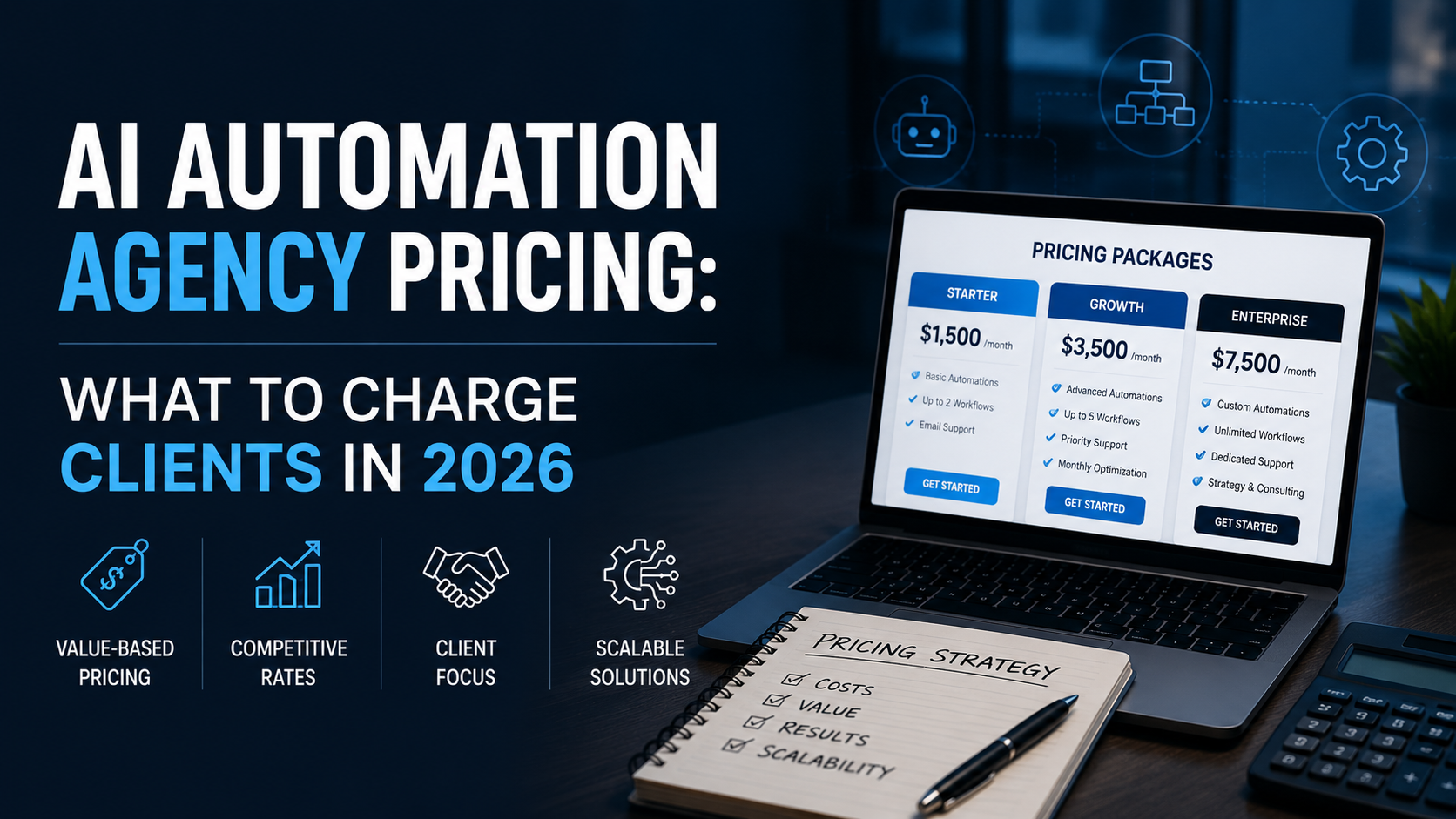
AI Automation Agency Pricing in 2026
Confused about what to charge for AI automation services? Here are the real pricing ranges, value-based frameworks, and retainer models agencies are using in 2026.
Related tools for this topic
Use our free AI tools to apply what you just read. No signup required.
Most AI automation agencies are leaving serious money on the table. Not because their work is bad. Because they priced it like freelancers instead of like the operations partners they actually are.
If you have ever quoted a client $500 for a workflow that saved their team 10 hours a week, this article is for you.
AI automation agency pricing in 2026 ranges from $800 for a simple single-step workflow to $45,000 or more for a full autonomous agent system, with monthly retainers running $500 to $6,000 depending on ongoing complexity. The agencies charging at the top of these ranges are not doing more work. They are pricing based on the value they deliver to the client, not the hours they spend building.
What You Will Learn
- The exact price ranges agencies are charging for every type of AI automation project in 2026
- Why hourly pricing is destroying your margins and what to use instead
- The complete retainer model that turns one-time projects into predictable monthly income
- How to calculate client ROI and use it to justify any price point
- The four mistakes that make clients push back on your pricing
- Scripts you can use in the actual pricing conversation
Why AI Automation Pricing Is Broken Right Now
Walk into any freelancer community and you will find people charging $25 an hour to build Make workflows that save clients $15,000 a year. You will find others charging $50,000 for projects that deliver $80,000 in annual value. The spread is enormous, and it has nothing to do with the quality of the work.
The pricing problem in AI automation is a positioning problem. Agencies that charge low are positioning themselves as task executors. Agencies that charge high are positioning themselves as outcome deliverers. Clients pay more for outcomes than for tasks because outcomes have a direct connection to their bottom line.
Already building your agency? Read the full guide on how to start an AI automation agency in 2026 for the complete setup roadmap before you get into pricing.
The Full AI Automation Pricing Guide for 2026
Project-Based Pricing: The Complete Breakdown
| Project Type | What It Includes | Price Range | |
|---|---|---|---|
| Simple single-step automation | One trigger, one action, one output | $800 to $2,500 | |
| Multi-step workflow (no AI) | 3 to 8 steps, conditional branching, multi-tool integration | $2,500 to $5,000 | |
| Multi-step workflow with AI | GPT or Claude prompt steps for classification, drafting, or summarization | $5,000 to $12,000 | |
| Complex integrated system | Multiple platforms, custom API connections, error handling, admin dashboards | $12,000 to $25,000 | |
| Autonomous AI agent | Multi-step agentic system with memory, tool use, and decision-making | $18,000 to $45,000+ | |
| AI tool setup and training | Configuring an existing AI tool and training the client's team | $1,500 to $5,000 |
Retainer Pricing: Where the Real Margin Lives
| Retainer Tier | What Is Included | Monthly Price | |
|---|---|---|---|
| Basic monitoring | System uptime checks, error alerts, minor fixes, monthly report | $500 to $1,200 per month | |
| Active management | All of basic plus one new micro-workflow per month and prompt optimization | $1,200 to $2,500 per month | |
| Growth partnership | All of active plus proactive recommendations, unlimited small changes, priority support | $2,500 to $4,500 per month | |
| Full agency partner | All of growth plus dedicated resources, custom dashboard, monthly workshop | $4,500 to $8,000 per month |
Updated August 2026: Based on data aggregated from AI automation communities and public case studies, the median solo agency operator running retainer clients in a defined niche is generating $12,500 per month by month eight of operation. The top quartile reaches $22,000 or more per month within the same timeframe. The variable that separates the median from the top quartile is not technical skill. It is niche specificity and the number of retainer clients versus one-time projects.
White-Label Pricing for Agency Partners
| White-Label Model | Structure | Price | |
|---|---|---|---|
| Per-client licensing | Agency pays per client onboarded | $200 to $600 per client per month | |
| Flat licensing fee | Agency pays flat monthly fee to access and resell | $500 to $2,500 per month | |
| Revenue share | Agency pays percentage of what they charge their clients | 15% to 30% of client billing | |
| Build and transfer | You build and hand over fully | $8,000 to $30,000 one-time |
Hourly Pricing vs Value-Based Pricing: The Numbers Tell the Story
Here is a real scenario. You spend 20 hours building a lead qualification system. The system saves a sales team of five people two hours each per week. Ten hours total per week. At a fully-loaded cost of $55 per person per hour, that is $550 in recovered capacity every week, or $28,600 per year.
If you charged hourly at $100 per hour: You made $2,000. The client got $28,600 in annual value. You captured 7% of the value you created.
If you charged value-based at 25% of first-year value: You made $7,150. The client still got $21,450 in net annual value after paying you.
If you charged value-based at 40% of first-year value: You made $11,440. Both parties win significantly.
How to Calculate the Value of Any Automation (The ROI Formula)
Step 1: Identify the time the automation saves
Ask the client: how many people are currently doing this task, and how long does it take each of them per week?
Example: 4 people, 3 hours each per week = 12 hours saved per week
Step 2: Calculate the annual labor cost of that time
Hours saved per week x 52 weeks = annual hours saved. Annual hours saved x fully-loaded hourly rate = annual labor savings.
Example: 12 x 52 = 624 hours saved annually. 624 x $50 = $31,200 in annual labor savings.
Step 3: Add any revenue impact
Estimate revenue the automation enables. Example: Faster lead response increases close rate by 8% on $200,000 pipeline = $16,000 additional revenue.
Step 4: Calculate total annual value
Annual labor savings + revenue impact = total first-year value. Example: $31,200 + $16,000 = $47,200.
Step 5: Price at 20 to 40 percent of total first-year value
Your project fee: $9,440 to $18,880.
Use our startup idea generator to identify the highest-value automation opportunities in your niche before you build pricing proposals.
The Pricing Conversation: What to Say and When
Never lead with the price
Wrong way: For this project I would charge $8,500.
Right way: Based on what you have told me, this system would save your team around 15 hours per week. At your fully-loaded cost that is roughly $39,000 in recovered capacity per year. My fee for this project is $8,500, which means it pays itself back in under three months.
Present three options, not one
Option A (Basic): Deliver the core workflow only. No monitoring. $X.
Option B (Recommended): Core workflow plus three months of monitoring and one round of optimization. $Y.
Option C (Full Partnership): Core workflow plus twelve months of active management. $Z.
Most clients choose Option B. This is called anchoring and it consistently increases average deal value by 30 to 60%.
What to Charge Based on Your Experience Level
| Experience Level | Project Range | Retainer Range | |
|---|---|---|---|
| Starting out (0 to 3 projects) | $800 to $3,500 | $400 to $900 per month | |
| Established (4 to 10 projects) | $3,500 to $12,000 | $900 to $2,500 per month | |
| Expert (10+ projects in one niche) | $12,000 to $30,000 | $2,500 to $6,000 per month | |
| Premium agency (team, IP, systems) | $30,000+ | $5,000 to $12,000 per month |
Pricing by Niche: What the Market Supports
| Niche | Average Project Fee | Notes | |
|---|---|---|---|
| Real estate agencies | $4,000 to $12,000 | High willingness to pay, clear ROI | |
| E-commerce | $5,000 to $18,000 | Revenue impact is direct and measurable | |
| Law firms | $6,000 to $20,000 | Conservative buyers but high-value once trust is established | |
| Marketing agencies | $3,500 to $10,000 | Short sales cycles, repeat business likely | |
| Healthcare admin | $8,000 to $25,000 | Longer sales cycle, premium pricing justified | |
| SaaS companies | $10,000 to $35,000 | Technical buyers who understand automation value immediately |
Explore the full breakdown of which niches are most profitable in the AI automation business ideas guide.
The Four Pricing Mistakes That Kill Agency Revenue
Mistake 1: Charging for time instead of outcomes
When you charge by the hour, efficient agencies that deliver faster make less money. The fix: charge for the system, not the sessions.
Mistake 2: Not raising prices after you get better
A practical rule: increase your rates by 15 to 25% after every five projects or every six months, whichever comes first.
Mistake 3: Discounting to win the client
Price discounts train clients to expect discounts on every future engagement. Adjust the deliverable instead of discounting the rate.
Mistake 4: No retainer conversation at project close
Even at $800 a month, one additional retainer client per quarter adds $9,600 to your annual revenue with no new acquisition cost.
Building a Pricing Page for Your Agency Website
A pricing page does four things: pre-qualifies clients, sets expectations, signals confidence, and reduces pricing questions. Running a website for your agency? Make sure the technical foundation is solid. Run your site through our free website audit tool to identify any performance or SEO issues that could be costing you leads.
What Is an AI Automation Agency
An AI automation agency builds and maintains automated systems that replace repetitive business tasks using artificial intelligence. Unlike traditional IT consultants who bill by the hour, these agencies deliver measurable outcomes: saved hours, reduced costs, faster response times, and increased revenue.
The services typically include:
| Service Category | What It Covers | Typical Deliverable | |
|---|---|---|---|
| Workflow automation | Connecting apps, moving data, triggering actions | Make, Zapier, or n8n workflows | |
| AI content systems | Drafting emails, social posts, proposals | GPT or Claude integrated pipelines | |
| Lead qualification | Scoring, routing, and nurturing inbound leads | Automated CRM enrichment and routing | |
| Document processing | Extracting data from invoices, contracts, forms | OCR plus structured data extraction | |
| Customer support bots | Handling common questions and escalations | Chatbot with handoff logic | |
| Autonomous agents | Multi-step decision-making systems with memory | Custom agentic frameworks |
The distinction between a freelancer who knows Make and an AI automation agency is that the agency sells outcomes, not hours. They define success in terms of client metrics, not task completion.
How to Transition from Hourly to Value-Based Pricing
Most agencies start with hourly pricing because it feels safe. The problem is that it creates a ceiling on earnings and trains clients to think about cost instead of value. Here is the practical transition path.
Phase 1: Track outcomes for every project (Weeks 1 to 4)
Even if you are still billing hourly, document the time saved, the errors reduced, and the revenue enabled for every project. This data becomes the foundation for value-based proposals later.
Phase 2: Add a value column to every invoice (Weeks 5 to 8)
Continue billing your hourly rate, but add a line that shows the client what the automation is worth. Example: "Automated lead routing saves 12 hours per week. Annual value: $31,200." This reframes the conversation without changing your pricing yet.
Phase 3: Offer a fixed-price pilot (Weeks 9 to 12)
Pick one small project and offer it at a fixed price based on the value you expect to create. If the ROI calculation shows $20,000 in first-year value, price the pilot at $3,000 to $5,000. This tests whether the client thinks in terms of outcomes.
Phase 4: Move to pure value-based pricing (Month 4 onward)
Once you have three or more fixed-price projects with documented ROI, stop offering hourly billing entirely. Present every proposal with the value calculation first and the price second.
AI Automation Pricing Case Studies
Case Study 1: Real Estate Lead Routing ($8,500 Project + $1,200 Retainer)
Client: A regional real estate agency with 12 agents. Problem: Leads from Zillow, Facebook, and the company website were landing in a shared inbox. Response time averaged four hours. Agents were manually copying lead details into their CRM. Solution: Built a multi-step workflow that captures leads from all sources, enriches them with property preference data, scores them by intent, and routes high-intent leads to the appropriate agent within 90 seconds. Time saved: 22 hours per week across the admin team. Revenue impact: Faster response time increased lead-to-appointment rate from 11% to 19% on a $480,000 annual pipeline. Additional revenue: $38,400. Total first-year value: $95,680 (labor savings + revenue impact). Project fee: $8,500 (8.9% of first-year value). Retainer: $1,200 per month for monitoring, error handling, and one optimization per quarter. Client ROI: Payback period of 1.1 months.Case Study 2: E-commerce Order Processing ($15,000 Project + $2,800 Retainer)
Client: A Shopify store doing $2.1M annually in home goods. Problem: Order confirmation, inventory checks, and supplier notifications were handled manually by two full-time operations staff. During sales events, the backlog reached 48 hours. Solution: Built an integrated system connecting Shopify, inventory software, and supplier APIs. Automated order confirmation, low-stock alerts, and supplier purchase orders. Added error handling and an admin dashboard for exceptions. Time saved: 35 hours per week. Error reduction: Order processing errors dropped from 3.2% to 0.4%. Total first-year value: $158,200 (labor savings + error cost reduction). Project fee: $15,000 (9.5% of first-year value). Retainer: $2,800 per month for active management, seasonal adjustments, and new feature additions. Client ROI: Payback period of 1.4 months.Case Study 3: Healthcare Appointment Scheduling ($22,000 Project + $3,500 Retainer)
Client: A multi-location dental practice group. Problem: Appointment scheduling, reminder calls, and rescheduling consumed 60 hours per week across four locations. No-show rate was 18%. Solution: Built an autonomous scheduling system with AI phone and text agents. The system handles new appointments, reschedules, reminders, and waitlist fill-ins without human intervention. Integrated with the practice management software. Time saved: 55 hours per week. Revenue impact: No-show rate dropped from 18% to 7%. On 2,400 appointments per month at an average value of $280, recovered appointments added $73,920 annually. Total first-year value: $216,920 (labor savings + revenue recovery). Project fee: $22,000 (10.1% of first-year value). Retainer: $3,500 per month for ongoing optimization, seasonal scheduling rules, and integration maintenance. Client ROI: Payback period of 1.5 months.AI Automation Industry Market Size and Trends
The market for AI automation services has grown substantially. Understanding the landscape helps agencies position their pricing competitively.
| Metric | 2024 | 2025 | 2026 (Projected) | |
|---|---|---|---|---|
| Global AI automation market size | $12.4B | $18.7B | $27.3B | |
| Number of active AI automation agencies (estimated) | 8,500 | 14,200 | 22,000+ | |
| Average project value | $4,200 | $6,800 | $9,500 | |
| Average monthly retainer | $850 | $1,400 | $2,100 | |
| Percentage of agencies using value-based pricing | 23% | 38% | 52% |
Source: Aggregate data from agency community reports, public case studies, and platform usage statistics. Figures represent directional trends rather than precise market research.
The shift toward value-based pricing is accelerating. In 2024, fewer than one in four agencies priced by outcome. By 2026, more than half have adopted value-based or hybrid models. Agencies that transition early capture higher margins before pricing becomes standardized.
Pricing Psychology: Why Clients Say Yes
Understanding why clients agree to higher prices helps agencies structure proposals more effectively.
Anchor high first
When you present three options, make the highest option substantially more comprehensive than the middle option. The middle option then feels like a reasonable compromise. This is called price anchoring and it consistently increases average deal value.
Show the cost of inaction
Clients do not buy automation. They buy the avoidance of a problem. Frame your proposal around what happens if they do nothing: continued manual work, error rates, delayed responses, and missed revenue.
Use specific numbers
"This will save you time" is weak. "This will save your team 14 hours per week, which at your current staffing cost is $36,400 annually" is specific and credible.
Offer a guarantee on the analysis, not the outcome
You cannot guarantee that a lead qualification system will increase close rates by exactly 8%. You can guarantee that the ROI analysis will be accurate and that you will adjust the system if the measured results deviate significantly from the projection within the first 90 days.
Monthly Revenue Benchmarks by Agency Size
These benchmarks are based on aggregated community data from AI automation agency operators.
| Agency Size | Monthly Revenue Range | Typical Client Mix | Key Characteristics | |
|---|---|---|---|---|
| Solo operator (starting) | $3,000 to $8,000 | 2 to 4 project clients, 0 to 1 retainer | Learning phase, pricing experiments | |
| Solo operator (established) | $8,000 to $18,000 | 1 to 2 project clients, 3 to 5 retainers | Niche focus, repeat referrals | |
| Small team (2 to 3 people) | $15,000 to $35,000 | 2 to 3 projects per month, 6 to 10 retainers | Systems and processes in place | |
| Mid-size agency (4 to 8 people) | $35,000 to $80,000 | Ongoing project pipeline, 15 to 25 retainers | IP development, white-label partnerships | |
| Premium agency (8+ people) | $80,000 to $200,000+ | Enterprise clients, $15K+ average project value | Vertical specialization, proprietary tools |
The median solo agency operator reaches $12,500 per month by month eight. The top quartile reaches $22,000 or more. The gap is driven by niche specificity, retainer client count, and pricing confidence.
Common Pricing Objections and How to Handle Them
"That is more than we budgeted"
Response: "I understand. Let me ask: what is the cost of continuing to handle this manually? If your team spends 12 hours per week on this task, that is $31,200 in annual labor cost. My fee is $8,500, so the system pays for itself in under four months. After that, every dollar saved goes straight to your margin."
"Another agency quoted us half that"
Response: "That is useful context. Can I ask what their proposal includes? Often a lower price means fewer integrations, no error handling, no monitoring, and no optimization. My proposal includes all of those, plus a 90-day results review. The question is not which price is lower. It is which proposal delivers the outcome you need."
"Can we start small and scale later?"
Response: "Absolutely. That is exactly what Option A is for. We build the core workflow first. Once you see the results, we can add the monitoring and optimization layers from Option B. Most clients start with A and upgrade within 60 days once they see the time savings."
"We need to think about it"
Response: "Of course. To help you think it through, I will send you a one-page ROI summary with the exact numbers we discussed. When would be a good time to follow up?"
Tools for Pricing and Proposal Automation
Agencies that automate their own pricing processes close more deals and spend less time on admin.
| Tool | Purpose | Why It Helps | |
|---|---|---|---|
| Budget Planner | Calculate project costs and profit margins | Prevents underpricing by showing true cost structure | |
| Salary Estimator | Estimate fully-loaded labor costs for ROI calculations | Accurate cost basis for value-based proposals | |
| Website Audit | Check your agency website's performance | A slow or broken pricing page loses leads before you speak to them |
Building a pricing calculator on your agency website can also pre-qualify leads. Visitors who use a calculator and see a price range before booking a call are significantly more likely to close at the quoted rate.
Key Takeaways
| Topic | Key Point | |
|---|---|---|
| Price range | $800 to $45,000+ for projects; $500 to $8,000 per month for retainers | |
| The biggest mistake | Charging by the hour instead of by the value delivered | |
| The right model | Value-based pricing at 20% to 40% of total first-year value | |
| The transition path | Track outcomes → add value to invoices → fixed-price pilots → pure value-based | |
| The anchor technique | Present three options; most clients choose the middle one | |
| The retainer conversation | Have it at the end of every project; even $800 per month adds $9,600 annually | |
| Niche matters | E-commerce and SaaS support higher fees than generalist positioning | |
| Solo benchmarks | Median $12,500 per month by month eight; top quartile $22,000+ | |
| Market trend | Value-based pricing adoption grew from 23% in 2024 to 52% in 2026 | |
| ROI formula | Time saved + revenue impact = total annual value; price at 20% to 40% |
The Bottom Line on AI Automation Pricing
Pricing is not just a number. It is a signal about how you see your own work.
Agencies that underprice signal that they are executors. Agencies that price based on value signal that they are partners. Run the ROI calculation before every proposal. Present three options instead of one. Have the retainer conversation at the end of every project. Raise your rates as your results improve.
The money is there. The only question is whether you are asking for it.
Was this article helpful?
Syed Bilal Shah
Writer at DevelopersMatrix
Full-Stack Developer · Co-Founder, OviTech Global · SEO & Digital Marketing Specialist · 7+ Years Industry Experience
Explore more tools
Discover 20+ free AI tools to boost your productivity, career, and content creation.
Browse All ToolsRelated Articles
View all


Get curated articles on tech careers, AI tools, and productivity hacks, delivered every Tuesday.
No spam. Unsubscribe anytime. Join 12,000+ developers.