
DevelopersMatrix
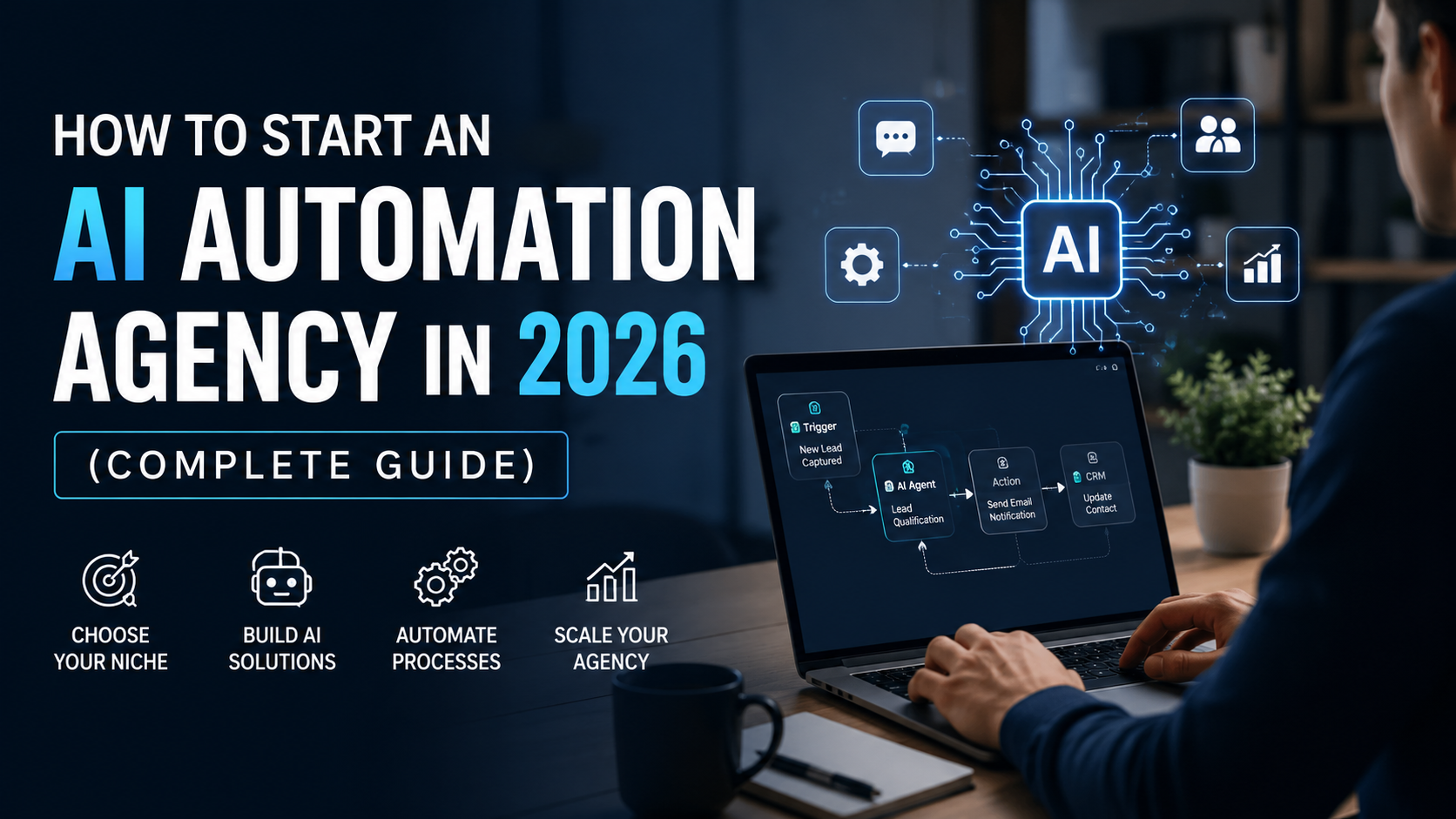
How to Start an AI Automation Agency in 2026 (Complete Guide)
StartupAI AutomationStartupBusinessEntrepreneurship

How to Start an AI Automation Agency in 2026 (Complete Guide)

Learn how to start a profitable AI automation agency in 2026. Real pricing, service models, tools, and client acquisition strategies no fluff, just what works.

SB
Syed Bilal Shah
July 30, 2026
18 min read
Share:

Related tools for this topic

Use our free AI tools to apply what you just read — no signup required.

How to Start an AI Automation Agency in 2026 (Complete Guide)

An AI automation agency is a business that builds and deploys AI-powered systems for other companies replacing manual, repetitive workflows with tools that run automatically using large language models, no-code platforms, and custom integrations. The agencies that are profitable in 2026 are not the ones selling vague "AI consulting." They are the ones delivering a specific, measurable outcome: time saved, revenue increased, or errors eliminated.

What You Will Learn in This Guide

  • The exact service models that AI automation agencies are selling in 2026 and what each one pays
  • Which niches have the most demand with the least competition right now
  • How to price your services from day one without underselling your work
  • The tools you actually need to start (and the ones you do not)
  • How to land your first three clients without an established reputation
  • What separates the agencies making $10k/month from the ones making $100k/month

What Is an AI Automation Agency (And Why 2026 Is the Right Time)

An AI automation agency is a business that builds and manages AI-powered workflows for other businesses. In plain terms: your clients have repetitive, time-consuming tasks, and you replace those tasks with systems that run themselves.

This is not the same as an AI consulting firm that writes strategy decks. Automation agencies deliver working systems. When you finish a project, something runs that did not run before a lead qualification bot, an automated content pipeline, a customer support agent, a data extraction workflow.

The timing matters. In 2024 and early 2025, most businesses knew AI existed but did not know what to do with it. By 2026, the conversation has shifted. Business owners now understand they need automation but do not have the internal skills to build it. That gap is your market.

According to McKinsey's 2025 AI Adoption Index, 67% of mid-sized businesses planned to automate at least three operational processes using AI within 12 months, yet fewer than 20% had someone internally capable of executing the implementation. That is the gap your agency fills.

The 5 Service Models That Are Actually Making Money in 2026

Before you pick a niche or write a proposal, you need to understand what AI automation agencies are actually selling. There are five models that are generating consistent revenue right now.

1. Done-for-You Workflow Automation

You build an automated system from scratch and hand it over to the client. They pay a project fee, you deliver a working system. Most common deliverables include lead intake automation, CRM data enrichment, internal reporting pipelines, and AI-assisted customer support flows.

Typical project fee: $3,000 to $15,000 depending on complexity Timeline: 2 to 6 weeks Best for: Agencies starting out, because it builds your portfolio fast

2. Monthly Retainer (Maintenance and Optimization)

After delivering a system, you charge a monthly fee to monitor performance, fix issues, and iterate on the automation as the client's needs change. This is where the real margin sits for established agencies.

Typical retainer: $800 to $3,500/month per client What it covers: System monitoring, prompt updates, integration maintenance, new workflow additions Best for: Scaling your agency to predictable monthly revenue

3. AI Tool Setup and Training

Some clients have already purchased AI tools a CRM add-on, a customer service AI, a content tool and have no idea how to set them up properly. You charge to configure, integrate, and train their team.

Typical fee: $1,500 to $5,000 per engagement Timeline: 1 to 3 weeks Best for: Agencies building breadth across multiple platforms (Zapier, Make, HubSpot AI, Salesforce Einstein)

4. AI Agent Development

This is the highest-value model in 2026. You build autonomous AI agents systems that can complete multi-step tasks without human oversight. Lead research agents, content publishing agents, sales outreach agents, and internal knowledge base agents are the most in-demand.

Typical project fee: $8,000 to $40,000 Retainer (post-delivery): $2,000 to $8,000/month Best for: Agencies with technical depth and a portfolio of successful automation projects
Want to see what autonomous AI agents are actually capable of? Read our breakdown of autonomous AI agents and how they work in 2026.

5. White-Label AI Systems for Agencies

You build AI automation systems that marketing agencies, web development firms, and consultancies resell to their own clients under their brand. You charge either a licensing fee or a percentage of what they bill.

Typical structure: $500 to $2,000/month licensing fee per agency partner Best for: Agencies that want to scale without increasing client-facing work

The Best Niches for AI Automation Agencies in 2026

Not all niches are created equal. The niches that are profitable right now have three things in common: the businesses in them have repetitive high-volume workflows, they are already spending money on software, and they are open to technology adoption.

Here are the niches that meet all three criteria.

Real Estate

Real estate agencies spend enormous time on lead follow-up, property listing management, appointment scheduling, and CRM data entry. All of these are automatable. A single real estate agency with 20 agents can save 15 to 20 hours per agent per week with well-built automation. At their billing rates, that is thousands of dollars in recovered time every week making your $5,000 project fee an easy sell.

Best automations to offer: Lead qualification bots, automated follow-up sequences, listing description generators, CRM enrichment

E-Commerce

Online stores deal with repetitive tasks at scale product description writing, customer support responses, inventory alerts, abandoned cart follow-up, and review management. Automation here is directly tied to revenue, which makes ROI conversations simple.

Best automations to offer: AI customer support agents, product description generation pipelines, return processing automation, dynamic pricing alerts

Professional Services (Law Firms, Accounting, Consulting)

These businesses charge clients by the hour and have more billable work than they can handle. Automating internal processes document review, client intake, report generation, meeting summaries lets them serve more clients without hiring more staff. The willingness to pay is high because the math is obvious.

Best automations to offer: Document summarization, client intake automation, meeting transcription and action item extraction, automated billing reminders

Marketing Agencies

Marketing agencies are sitting on piles of repetitive work: content briefs, social media posts, performance reports, client updates, keyword research compilations. Most have already tried basic AI tools but have not built integrated workflows. This is a warm market with clear pain points.

Best automations to offer: Content repurposing pipelines, automated reporting dashboards, SEO brief generation, social media scheduling systems

Healthcare (Non-Clinical)

Healthcare administration appointment scheduling, insurance verification, patient communication, intake forms is manual, error-prone, and expensive. Non-clinical automation is legal, in demand, and underserved by most agencies who are intimidated by the sector.

Best automations to offer: Appointment reminder systems, patient intake automation, insurance pre-authorization workflows, billing follow-up sequences
Use our AI startup idea generator to identify which niche fits your existing skills and network.

AI Automation Agency Pricing: What to Charge in 2026

This is where most new agency owners get it wrong. They either underprice out of insecurity or overprice without being able to justify the number. Here is a transparent pricing framework based on what agencies are actually charging in 2026.

Project-Based Pricing

Automation ComplexityDescriptionPrice Range
Simple single-step automationOne trigger, one action. Example: form submission triggers a Slack notification and creates a CRM record.$800 to $2,500
Multi-step workflow3 to 7 steps with conditional logic. Example: lead comes in, is qualified by AI, assigned to a rep, and added to a follow-up sequence.$2,500 to $8,000
Complex integrated systemMultiple tools, API connections, custom prompts, AI decision-making. Example: full lead intake, qualification, outreach, and reporting pipeline.$8,000 to $25,000
Autonomous AI agent buildMulti-step agentic system with memory, tool use, and independent decision-making.$15,000 to $45,000+

Retainer Pricing

After project delivery, move clients to a monthly retainer. Do not leave revenue on the table by treating every client as a one-time project.

Retainer TierWhat Is IncludedMonthly Price
Basic maintenanceMonitoring, bug fixes, minor updates$500 to $1,200/month
Active managementMonitoring plus one new workflow/month plus optimization$1,200 to $2,500/month
Full partnershipUnlimited changes, proactive recommendations, priority support$2,500 to $6,000/month

How to Justify Your Price to a Client

The conversation is simple. Calculate the time the automation saves per week, multiply by the client's labor cost per hour, and show them the annual number. A workflow that saves a five-person team two hours each per week is saving the business roughly 520 hours per year. At $50/hour fully loaded, that is $26,000 in recovered capacity annually. Your $8,000 project pays itself back in under four months.

The Tools You Need to Start (And the Ones You Do Not)

You do not need a custom-coded platform to start an AI automation agency. The tools below cover 90% of what agencies are building in 2026.

No-Code Automation Platforms

Make (formerly Integromat) The most flexible no-code automation platform. Better than Zapier for complex, multi-branch workflows. Most agencies building serious automation use Make as their primary platform. Zapier Simpler and better for clients who want to manage their own automations after delivery. Higher per-task cost than Make at volume, but easier for non-technical clients. n8n Open-source, self-hosted option. Best for agencies building for clients who have data privacy requirements or want to avoid ongoing subscription costs.

AI Model Access

OpenAI API GPT-4o is the default for most text-based automation tasks. You will use this for classification, summarization, drafting, and extraction tasks inside your workflows. Anthropic API (Claude) Better for longer context tasks, document analysis, and tasks requiring careful reasoning. Many agencies use both OpenAI and Anthropic depending on the task. Google Gemini API Strongest for multimodal tasks involving images, PDFs, and documents alongside text.

Supporting Tools

Airtable For building client-facing databases that connect to your automations. Notion AI For internal documentation and client-facing knowledge bases. Slack For building client-facing notification and approval bots. Cal.com For scheduling automation integrations.

What You Do Not Need Yet

You do not need a custom-built platform. You do not need proprietary software. You do not need a team of developers. You do not need an office or expensive infrastructure. Start with Make or Zapier plus OpenAI API access and build from there.

How to Land Your First Three Clients

The biggest myth about starting an agency is that you need case studies before anyone will hire you. You do not. You need specificity and credibility, which are different things.

Step 1: Pick a niche before you talk to anyone

A generic "I do AI automation" pitch gets ignored. "I build lead qualification systems for real estate agencies that cut follow-up time by 60%" gets a response. Your niche is your credibility signal before you have any case studies.

Step 2: Find five businesses in your niche with obvious automation gaps

Search LinkedIn for operations managers, office managers, or agency owners in your chosen niche. Look at their job descriptions and tool stacks. A real estate agency listing "manual CRM data entry" as a pain point is a pre-qualified lead. You are not selling them AI you are solving a specific problem they have already named.

Step 3: Offer a free audit, not a free trial

Contact them and offer a free workflow audit. You will review one specific process their lead intake, their client onboarding, their reporting and identify exactly where automation can save them time. This demonstrates expertise without giving away your actual service. It also creates a natural transition into a paid engagement because they can see what needs fixing.

Before you audit a client's workflow, run their website through our free website audit tool to understand their digital setup and identify any obvious technical gaps you can address.

Step 4: Turn the first client into a case study immediately

Document everything from the first engagement. Time saved before versus after. Errors reduced. Hours recovered. Revenue influenced. This becomes your proof of concept for every subsequent pitch. One detailed case study with real numbers is worth more than a full portfolio of generic descriptions.

Step 5: Ask for introductions, not referrals

At the end of every project, do not ask "do you know anyone who might need this?" Ask "who is the most time-strapped person in your industry that you respect?" That question gets you a warm introduction instead of a vague suggestion.

Building Your AI Automation Agency: The First 90 Days

Days 1 to 30: Foundation

Pick your niche. Build one automation as a demo a real working system in your chosen vertical that you can show prospects. Set up your basic business infrastructure: a simple website, a Calendly link, a proposal template, and a basic contract.

Do not overthink the website. You need a one-page site with your niche, your service, your process, and a way to contact you. That is it. You can rebuild it later.

Reach out to 20 people in your niche per week. Not to sell to have conversations. Learn their workflows, their tools, their frustrations. This research makes your pitch sharper than anything else you will do this month.

Days 31 to 60: First Revenue

By day 30 you should have had at least three substantive conversations with potential clients. One of them is ready to move forward. Offer a clearly scoped pilot project one specific automation, fixed scope, fixed price. Deliver it. Document the results.

While you are delivering the pilot, start building your client acquisition system. A simple email sequence. A LinkedIn outreach template. A content piece or two that demonstrates your expertise in your niche.

Days 61 to 90: Scale to Predictable Income

Convert your pilot client to a retainer. Use the case study from the pilot to close a second client. By day 90, you should have at least one retainer client paying you monthly and a second project in progress.

This is not a theoretical timeline. It is the actual path most solo agency operators follow. The gap between people who follow this sequence and people who do not is specificity and execution speed, not skills or tools.

What Separates a $10k/Month Agency From a $100k/Month Agency

The difference is not technical skill. It is systems, positioning, and productization.

The $10k/month agency does custom projects for any client in any niche, prices based on hourly rates, and is always busy but rarely scaling. The $100k/month agency has three to five standardized service packages in a specific niche, charges based on value delivered, has a repeatable sales process, and spends less time doing client work because the systems they build are similar enough to be templated.

The path from one to the other is choosing a niche deeply enough that you can systematize your delivery. When your fifth real estate agency client needs the same lead qualification system as your first, you are not starting from scratch. You are adapting a template. That is where margin lives.

Common Mistakes That Kill AI Automation Agencies in the First Year

Trying to be everything to everyone. Agencies that serve every industry and every automation type have no differentiation and no repeatable process. Pick a niche. Underpricing to win clients. Clients who buy on price will leave on price. Value-based pricing attracts clients who care about outcomes, which are the clients worth keeping. Over-delivering on the first project. Building a complex, over-engineered system for a first client who needed something simple creates support nightmares and eats your margin. Deliver exactly what was scoped. Skipping the retainer conversation. Every project should end with a conversation about ongoing maintenance. Failing to have this conversation is leaving recurring revenue unclaimed. Building without documenting. If you cannot hand off a system or explain it to a client's internal team, you are creating dependency problems. Document every workflow, every prompt, every integration, every decision point.

Frequently Asked Questions

What does an AI automation agency actually do?

An AI automation agency builds systems that replace manual, repetitive work with automated workflows powered by artificial intelligence. This includes things like automated lead qualification, AI-assisted customer support, intelligent document processing, and autonomous data collection. The agency handles the technical build connecting AI tools, writing prompts, integrating platforms and delivers a working system the client uses on an ongoing basis.

How much can you realistically earn from an AI automation agency in 2026?

A solo operator in a specific niche can realistically reach $8,000 to $15,000/month within six to twelve months. This typically means three to five retainer clients plus one to two active projects. Agencies with a small team (two to five people) operating in a defined vertical commonly reach $30,000 to $80,000/month. The ceiling for a specialized agency with productized services and a sales system is significantly higher, but most operators stabilize in the $15,000 to $50,000/month range within two years.

Do you need to know how to code to start an AI automation agency?

No. The majority of AI automation agencies in 2026 operate entirely on no-code platforms like Make, Zapier, and n8n combined with AI APIs. Technical coding skills are useful and increase your ceiling for complex projects, but they are not required to start. Many successful agency operators are former project managers, marketers, or operations professionals who learned Make and the OpenAI API without any prior development background.

What are the best niches for an AI automation agency in 2026?

The most profitable niches for AI automation agencies in 2026 are real estate, e-commerce, professional services (law firms, accounting), marketing agencies, and healthcare administration. These verticals share the same characteristics: high-volume repetitive workflows, an existing willingness to pay for software solutions, and a clear ROI story for automation. The niches to avoid are those where buyers are highly price-sensitive (very small local businesses), heavily regulated without clear non-clinical automation paths, or too large to close without a long enterprise sales cycle.

How long does it take to build and deliver an AI automation system?

It depends on complexity. A simple single-step automation takes one to three days to build and test. A multi-step integrated workflow with AI decision-making takes one to three weeks. A full autonomous agent system can take four to eight weeks. Most agencies scope their first client projects conservatively to account for the learning curve and build in buffer time. Underestimating delivery timelines is one of the most common mistakes in the first year.

How do I price my AI automation services?

Price based on the value you deliver, not the time it takes. Calculate the hours your automation saves per week, multiply by the client's labor cost, and show the annual ROI. Your project fee should be less than the first three to four months of value created. For a workflow that saves a five-person team two hours each per week at $40/hour fully loaded, the annual value is $20,800. A $5,000 project fee is clearly justified. Retainers should be priced relative to the ongoing value of monitoring and maintaining a system the client depends on typically $800 to $3,500/month depending on complexity.

What tools do I need to start an AI automation agency?

The essential tools are Make or Zapier for workflow automation, access to the OpenAI API (and optionally Anthropic API), Airtable or Google Sheets for data management, and a simple website with a booking link. Total starting cost for tools is typically $100 to $300/month, which is recovered from a single client project in the first month.

The Honest Bottom Line

Starting an AI automation agency in 2026 is one of the most accessible high-income business models available to someone with technical curiosity and a willingness to learn. The market is not saturated. The demand is real. The tools are accessible.

What separates the agencies that grow from the ones that stall is the same thing it has always been: specificity, follow-through, and the discipline to productize what is working instead of reinventing it for every new client.

Pick one niche. Build one great system. Document everything. The rest follows from that.

If you are still exploring which AI business model fits your skills and resources, explore the ideas in our AI automation business ideas breakdown or generate a custom concept with our startup idea generator.

About the Author

Syed Bilal Shah has built AI automation systems for businesses across real estate, e-commerce, and professional services. They cover AI business models, automation tools, and growth strategy at DevelopersMatrix a resource for developers, marketers, and professionals building with AI.

Last updated: July 2026 | DevelopersMatrix.com

Was this article helpful?

Validate Your Business Idea in Seconds

Get AI-generated startup ideas with market analysis and MVP timelines.

SB

Syed Bilal Shah

Writer at DevelopersMatrix

Full-Stack Developer · Co-Founder, OviTech Global · SEO & Digital Marketing Specialist · 7+ Years Industry Experience

Published July 30, 202618 min read

Explore more tools

Discover 20+ free AI tools to boost your productivity, career, and content creation.

Browse All Tools
Weekly Newsletter

Get curated articles on tech careers, AI tools, and productivity hacks — delivered every Tuesday.

No spam. Unsubscribe anytime. Join 12,000+ developers.