
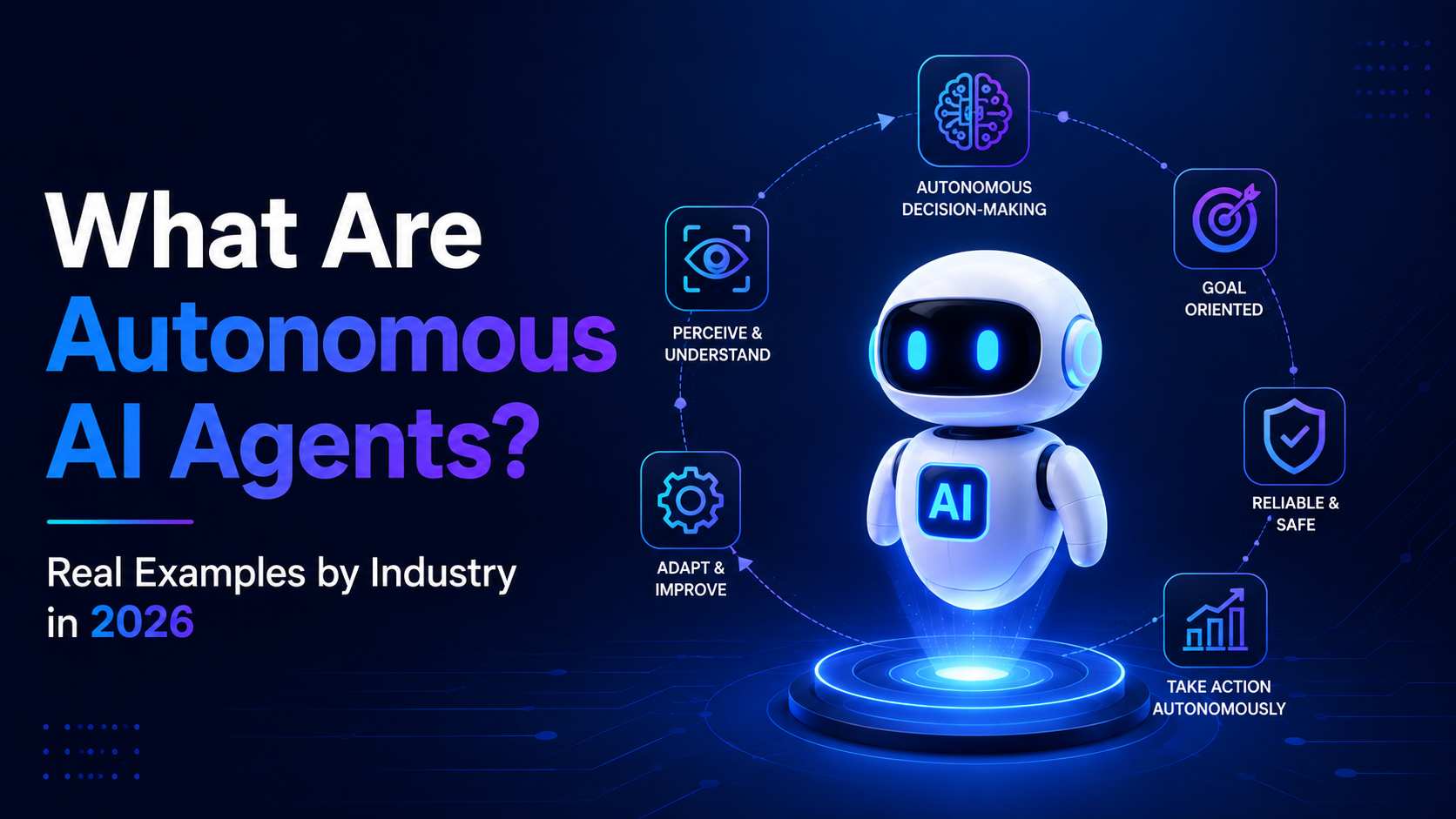
What Are Autonomous AI Agents? 2026 Examples
Autonomous AI agents make decisions and complete multi-step tasks independently. Here are real examples across healthcare, finance, retail, legal, manufacturing, and marketing in 2026.
Related tools for this topic
Use our free AI tools to apply what you just read. No signup required.
An autonomous AI agent is a software system that perceives its environment, makes independent decisions, and executes multi-step tasks without requiring a human to direct each step. Unlike a chatbot that responds to prompts or basic automation that follows fixed rules, an autonomous agent sets subgoals, uses tools, remembers context across sessions, and adapts its approach when it encounters obstacles. In 2026, autonomous AI agents are in active production deployment across healthcare, financial services, e-commerce, legal, manufacturing, and marketing handling tasks that previously required dedicated human operators.
What You Will Learn
- The precise difference between an AI agent, a chatbot, and traditional automation
- How autonomous AI agents actually work technically without the jargon
- Real, specific examples of agents deployed in six major industries right now
- Which agent frameworks and tools are being used to build them
- The honest risks and limitations that most coverage ignores
- How to identify whether a task in your business is a good candidate for an agent
Why This Question Matters More Than It Did a Year Ago
Twelve months ago, autonomous AI agents were largely a research and early-adopter topic. By mid-2026, they are in production at scale. According to PwC's AI Business Barometer Q3 2026, 71% of Fortune 500 companies now have at least one autonomous AI agent in active deployment, up from 52% in Q4 2025. The fastest-growing adoption is in financial services at 78%, followed by technology at 74% and healthcare at 63%.
The terminology matters because it is being used loosely. Marketing teams attach "agentic AI" to products that are nothing more than scripted automation. Understanding what an agent actually is and what it is not determines whether you evaluate the right tools, set realistic expectations, and avoid expensive implementations that do not match your actual needs.
Autonomous AI Agents vs Chatbots vs Traditional Automation
This comparison is the clearest way to understand what makes an agent different from the tools most people already use.
| Feature | Traditional Automation | Chatbot / AI Assistant | Autonomous AI Agent | |
|---|---|---|---|---|
| Decision making | Rule-based only follows fixed logic | Responds to prompts no independent action | Independent, goal-driven sets subgoals | |
| Multi-step tasks | Limited, pre-defined sequences | Single session only | Yes, across sessions and tools | |
| Memory | None between runs | Within session only | Persistent across sessions | |
| Handles unexpected situations | Fails or requires human intervention | Asks for clarification | Adapts approach independently | |
| Tool use | Fixed integrations only | Limited or none | Searches, reads, writes, calls APIs | |
| Human input required | At setup, then per trigger | Every interaction | At goal-setting only | |
| Best for | Repetitive, unchanging, structured tasks | Q&A, drafting, single-turn requests | Complex, variable, multi-step workflows | |
| Examples | Zapier flows, Make automations | ChatGPT, Claude, Gemini | AutoGPT, LangGraph agents, CrewAI workflows |
The practical line: if the system cannot make a decision when it encounters something it did not expect, it is not an agent. If it can adapt, retry a different approach, or call a different tool to complete the goal, it qualifies.
How Autonomous AI Agents Actually Work
An agent has four core components working together. Understanding these makes it easier to evaluate agent products and spot the ones that are real versus those that just use the label.
Perception The agent reads its environment. This could mean reading emails, scanning web pages, querying a database, ingesting documents, or monitoring system logs. The agent needs inputs to know what state the world is in before it can decide what to do. Reasoning A large language model GPT-4o, Claude 3.5, Gemini 1.5, or an open-source equivalent processes the inputs and generates a plan. This is where the intelligence comes from. The model decides which subgoals to pursue, in what order, and which tools to use. Action The agent uses tools to affect the world: writing to a database, sending an email, making an API call, browsing a website, generating a document, running a code function. Actions are how the agent makes things happen rather than just understanding them. Memory Without memory, every session starts from zero. Effective agents maintain working memory within a session (what has happened so far in this task) and long-term memory across sessions (what they learned about this client, this system, this recurring task). Vector databases like Pinecone and Weaviate are commonly used for long-term agent memory.The loop is: perceive → reason → act → perceive again. The agent keeps cycling through this loop until the goal is achieved, it gets stuck and escalates, or it decides the goal is not achievable with available tools.
Real Autonomous AI Agent Examples by Industry in 2026
Healthcare: Clinical Documentation and Patient Communication
The most common healthcare deployment in 2026 is clinical documentation agents systems that listen to or read clinical encounters, extract structured information, and populate electronic health records without physician data entry.
Real example: Ambient clinical intelligence agents from companies like Nuance (Microsoft DAX Copilot) and Suki AI listen to the patient encounter in real time, generate a structured clinical note in the correct format for the EHR, and surface it for physician review and one-click approval. The physician's manual documentation time drops from 15 to 20 minutes per encounter to under two minutes. Why it qualifies as an agent: The system handles variation different physicians have different speaking styles, different specialties use different terminology, encounters go in unexpected directions. The agent adapts its extraction and structuring approach to each encounter rather than following a fixed template.Second major deployment: patient intake and communication agents that handle appointment scheduling, insurance verification, pre-appointment instructions, and post-visit follow-up across phone, SMS, and patient portal without human coordination staff.
Financial Services: Fraud Detection and Trade Execution
Financial services leads all industries in autonomous agent adoption and has the most mature deployments.
Real example: JPMorgan Chase's IndexGPT and similar proprietary systems act as autonomous research and analysis agents given a research objective (analyze the risk profile of a specific bond portfolio under three macro scenarios), the agent independently gathers market data, runs quantitative models, synthesizes findings from multiple sources, and produces a structured analysis report. A task that previously required an analyst team working for several days completes in hours.Fraud detection agents monitor transaction streams in real time, apply behavioral models, cross-reference against known fraud patterns and entity databases, and autonomously block suspicious transactions, freeze accounts, or escalate for human review with the decision made in under 100 milliseconds.
In retail banking: Loan underwriting agents gather applicant data from multiple sources, run credit models, apply regulatory compliance checks, and produce a decision with full documentation reducing underwriting time from days to hours for standard applications.E-Commerce and Retail: Customer Support and Inventory Management
E-commerce was an early adopter of AI agents because the use cases are well-defined and the ROI is direct.
Real example: Shopify merchants using Tidio or Gorgias AI agents have agents that handle the full customer service lifecycle for common issues: order tracking, return initiation, exchange processing, refund authorization, and shipping disputes. The agent queries the order management system, determines eligibility, executes the transaction, and updates the customer without any human involvement. Resolution time drops from hours to under two minutes. Inventory management agents monitor stock levels, sales velocity, supplier lead times, and seasonal demand patterns across all SKUs continuously. When inventory for a product is predicted to drop below a threshold given current sales velocity, the agent generates and submits a purchase order to the supplier, logs the transaction, and notifies the operations team. Manual purchase order creation previously a major operational bottleneck becomes fully automated.Legal: Contract Review and Due Diligence
Legal is adopting agents rapidly despite the high-stakes nature of the work, primarily for document-heavy tasks where accuracy and thoroughness matter more than speed.
Real example: Large law firms using Harvey AI or Luminance deploy agents for due diligence in M&A transactions. Given a data room of thousands of documents, the agent reads every document, identifies and extracts key terms and clauses, flags deviations from standard terms, identifies missing documents, and produces a structured due diligence report with citations. A process that previously took a team of associates weeks of document review completes in hours. Contract review agents read proposed contracts, compare terms against the organization's playbook, identify non-standard clauses, assess risk exposure on specific provisions, and generate a redline with suggested changes before any human lawyer reads the document.Manufacturing: Quality Control and Predictive Maintenance
Manufacturing agents operate in physical systems, creating a tighter feedback loop between AI decisions and real-world consequences.
Real example: BMW and similar manufacturers deploy computer vision agents on production lines that inspect components for defects surface flaws, dimensional errors, assembly mistakes at rates and consistency levels impossible for human inspectors. The agent classifies each component in real time and signals the line to divert defective parts. Predictive maintenance agents continuously analyze sensor data from production equipment vibration, temperature, acoustic signatures, current draw and build predictive models of component failure. When the model identifies a pattern that precedes failure with sufficient confidence, the agent schedules maintenance, orders replacement parts, and notifies the maintenance team before the equipment fails, preventing unplanned downtime.Marketing: Content Pipelines and Campaign Optimization
Marketing was one of the earliest industries to experiment with AI agents and now has some of the most sophisticated production deployments.
Real example: Performance marketing teams at large e-commerce companies use agents that monitor campaign performance across ad platforms (Google, Meta, TikTok), apply attribution models, identify underperforming and overperforming ad sets, adjust bids and budgets within defined parameters, pause low-performing creatives, and generate a daily performance summary entirely without human intervention in the optimization loop. Content repurposing agents take a single piece of long-form content a blog post, a podcast episode, a webinar and autonomously produce an array of derivative content: social posts for each platform, an email newsletter version, a short-form video script, pull quotes for LinkedIn, and a thread format for X. Each output is adapted for the platform rather than copy-pasted.For a comprehensive breakdown of how autonomous AI agents are deployed across all major industries with adoption rates and use case depth, see our full guide to autonomous AI agents by industry in 2026.
The Agent Frameworks Powering These Deployments
Most enterprise AI agents in 2026 are built on one of these frameworks. Knowing which one is relevant to your context helps you evaluate vendors and build internal capability.
| Framework | Maintained By | Best For | Key Feature | |
|---|---|---|---|---|
| LangGraph | LangChain | Complex multi-step agents with state management | Graph-based workflow control, deterministic execution | |
| CrewAI | CrewAI | Multi-agent systems where agents collaborate | Role-based agent teams, task delegation | |
| AutoGen | Microsoft Research | Research and analysis agents, code generation | Conversation-driven multi-agent coordination | |
| OpenAI Assistants API | OpenAI | Rapid deployment with GPT-4o | Built-in tool calling, file search, code interpreter | |
| Anthropic Tool Use | Anthropic | Agents requiring careful reasoning | Claude's extended thinking, document analysis | |
| Semantic Kernel | Microsoft | Enterprise integration with existing Microsoft stack | .NET and Python SDK, Azure-native deployment | |
| LlamaIndex | LlamaIndex | Knowledge-intensive agents over large document stores | RAG-optimized, structured data extraction |
Organizations deploying AI agents should ensure their web infrastructure meets security and performance standards first. Run a website technical audit to identify any gaps.
What Autonomous AI Agents Cannot Do Yet
The honest limitations are as important as the capabilities for anyone making implementation decisions.
They hallucinate. Every agent built on a large language model inherits that model's tendency to generate plausible-sounding but incorrect information, particularly when the model is uncertain. In high-stakes applications medical, legal, financial this makes human review of agent outputs essential, not optional. They struggle with genuine novelty. Agents perform well on tasks that are within the distribution of their training data and within the scope of the tools they have been given. Genuinely novel situations a scenario the agent has never seen anything like produce unreliable behavior. They have context limits. Even with large context windows, agents working on very long or complex tasks can lose track of earlier context. Tasks that span weeks, involve thousands of documents, or require maintaining very complex state are still challenging. They are costly at scale. Running LLM inference for every agent decision is expensive. Organizations that deploy agents at high volume quickly discover that the compute cost can outweigh the labor savings if the agent is not operating efficiently. Security is a real concern. Agents with broad access to systems the ability to send emails, make API calls, modify databases are also a risk surface. Prompt injection attacks where malicious content in the environment tries to redirect the agent's behavior are an active attack vector that most current deployments have inadequate defenses against.How to Identify a Good Agent Use Case
Not every task benefits from an agent. The best agent use cases share these characteristics:
The task involves multiple steps that depend on the results of earlier steps. The task involves gathering information from multiple sources or systems. The task requires making decisions based on variable inputs rather than fixed rules. The task recurs regularly but varies enough each time that a fixed automation breaks. The task would require a human to spend significant time on coordination or information gathering rather than judgment.
Tasks that are genuinely fixed and predictable are better served by traditional automation, which is cheaper, faster, and more reliable. Reserve agents for tasks where the variability and judgment requirements make rigid automation impractical.
If you are exploring which AI automation opportunities make sense for a business you are building, our startup idea generator can surface agent-powered business models aligned with your skills and market.
Autonomous Agents and AI Automation Agencies
One of the fastest-growing business models in 2026 is building and selling autonomous AI agent systems for other businesses. An AI automation agency that specializes in agent development particularly for a specific industry vertical can command significantly higher rates than agencies doing simpler workflow automation.
The demand is driven by the adoption data: 71% of Fortune 500 companies want agents, but fewer than 30% of mid-market businesses have the internal capability to build them. That gap is the market.
For a detailed breakdown of AI automation business models, pricing, and how to start an agency around agent development, see our AI automation business ideas guide.
Frequently Asked Questions
What is an autonomous AI agent in simple terms?
An autonomous AI agent is a software program that can complete complex tasks on its own, making decisions and using tools without needing a human to direct each step. You give it a goal research competitors, process these invoices, monitor this system for issues and it figures out how to achieve the goal, handles problems it encounters along the way, and reports back when done or when it needs help.
How is an autonomous AI agent different from a chatbot?
A chatbot responds to questions and prompts within a single conversation and cannot take actions outside that conversation. An autonomous AI agent can take actions in the real world sending emails, updating databases, making API calls, browsing websites execute tasks over extended periods across multiple sessions, and adapt when it encounters obstacles. A chatbot answers. An agent acts.
What are the best autonomous AI agent examples in 2026?
The most mature and widely deployed examples include clinical documentation agents in healthcare that populate electronic health records from physician-patient encounters, fraud detection agents in financial services that make real-time transaction blocking decisions, customer service agents in e-commerce that handle returns and refunds end-to-end, contract review agents in legal that analyze documents against firm playbooks, and campaign optimization agents in marketing that autonomously adjust ad budgets and bids.
What tools do you need to build an autonomous AI agent?
The core requirements are access to a large language model API (OpenAI, Anthropic, or Google), an agent framework (LangGraph, CrewAI, AutoGen, or OpenAI Assistants), tool integrations for whatever systems the agent needs to interact with, and a memory layer for persistent context. For no-code or low-code agent deployment, platforms like Make and n8n support agentic workflows with AI decision nodes. For production-grade agents, most teams use Python-based frameworks with proper testing and monitoring.
Are autonomous AI agents safe to use in business?
Safety depends heavily on the scope of the agent's access and the stakes of the decisions it makes. Most enterprise deployments in 2026 use a human-in-the-loop approach for high-stakes decisions the agent handles research, drafting, and execution while a human approves outputs before they take effect. Agents with write access to critical systems, customer communications, or financial transactions need clear escalation paths, audit logging, and access controls. Start with read-only or low-stakes tasks and expand access as you build confidence in the agent's reliability.
How much does it cost to build an autonomous AI agent?
The cost varies enormously by complexity. A simple agent using the OpenAI Assistants API for a single, well-defined task can be built in a few days for minimal API costs. A production-grade multi-step agent with robust error handling, memory, monitoring, and integrations into enterprise systems is a multi-week engineering project costing $15,000 to $50,000 or more to build, plus ongoing compute costs. Hiring an AI automation agency to build and maintain a custom agent typically runs $8,000 to $40,000 for the build and $1,500 to $5,000 per month for ongoing management.
What industries are using autonomous AI agents the most in 2026?
Financial services leads adoption at 78% of tier-1 banks, followed by technology at 74%, e-commerce and retail at 61%, healthcare at 63%, and marketing agencies at 41%. Manufacturing is at 52% for Fortune 500 companies. The common thread in high-adoption industries is high document and data volume, repetitive but variable workflows, and sufficient regulatory clarity to deploy automation with appropriate oversight.
The Bottom Line
Autonomous AI agents are not a future technology you are preparing for. They are a present technology that leading organizations are deploying now to handle work that previously required dedicated human operators.
The question is not whether agents will matter for your industry. They already do. The question is whether you understand them well enough to evaluate real implementations versus hype, identify the right use cases in your context, and avoid the common implementation failures that come from rushing deployment before establishing governance.
Start with one well-defined, lower-stakes task. Instrument it. Learn from it. Then expand.
Was this article helpful?
Syed Bilal Shah
Founder & Lead Developer
Full-Stack Developer · Co-Founder, OviTech Global · SEO & Digital Marketing Specialist · 7+ Years Industry Experience
Explore more tools
Discover 20+ free AI tools to boost your productivity, career, and content creation.
Browse All ToolsRelated Articles
View all


Get curated articles on tech careers, AI tools, and productivity hacks, delivered every Tuesday.
No spam. Unsubscribe anytime. Join 12,000+ developers.