
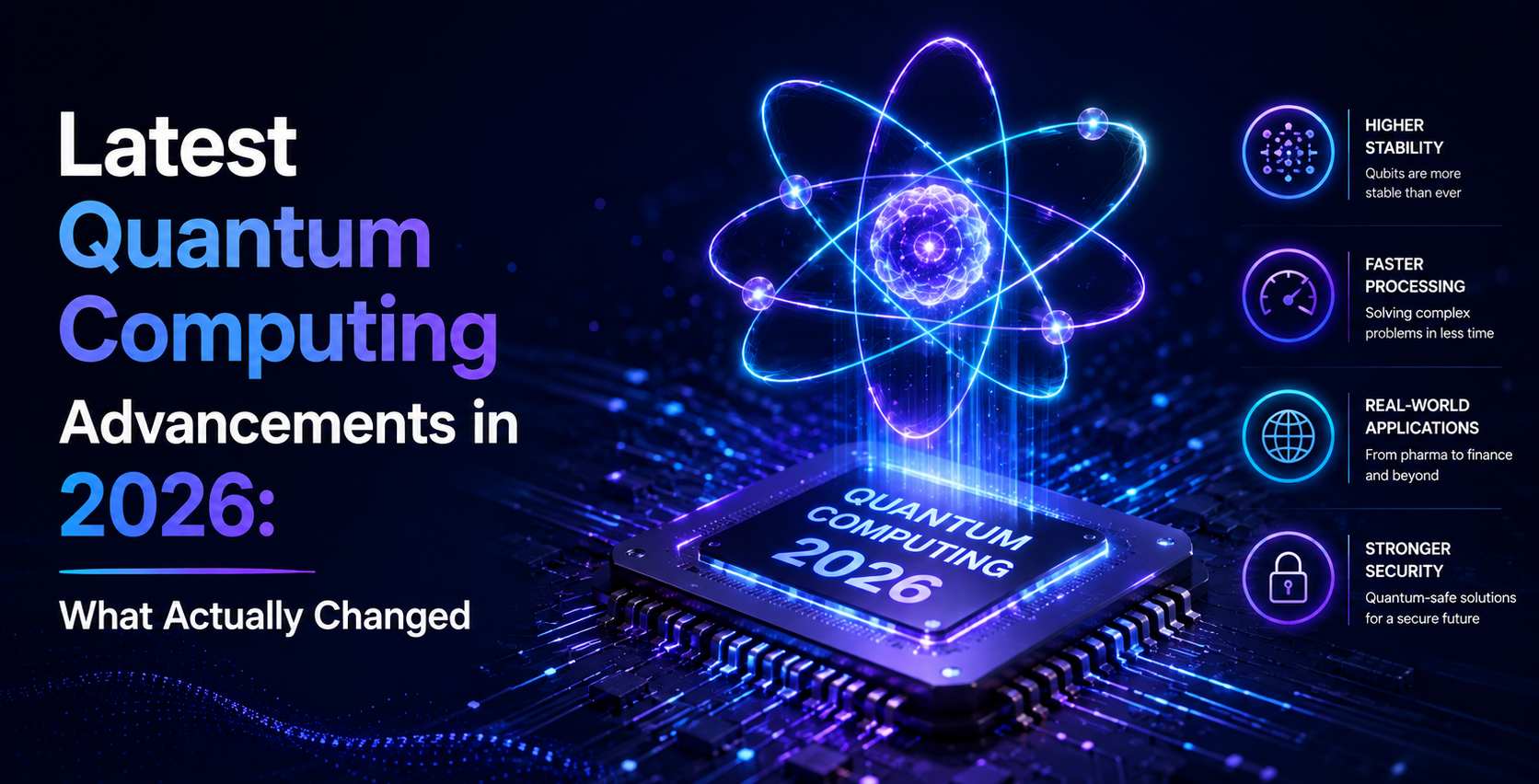
Quantum Computing Breakthroughs 2026
The quantum computing news that mattered in 2026, from error correction milestones to rising qubit counts and the first enterprise pilots to ship.
Related tools for this topic
Use our free AI tools to apply what you just read. No signup required.
What You Will Learn
- Which quantum computing milestones in 2026 are genuinely significant versus marketing noise
- The real difference between physical qubits and logical qubits and why it matters for practical use
- Where quantum computing is being deployed in actual enterprise applications right now
- How close we are to quantum advantage in specific problem domains
- What developers and businesses should realistically expect from quantum computing in the next three years
- How quantum progress connects to AI and automation capabilities being built today
Why 2026 Is a Different Kind of Year for Quantum Computing
Every year for the past decade, someone has declared it a breakthrough year for quantum computing. Most of those declarations were premature. The difference in 2026 is that the progress is no longer purely academic.
Three things changed simultaneously. Error correction crossed a threshold that makes scaling plausible. Cloud access to quantum processors became commercially available through multiple providers rather than just research partnerships. And the first verticals, specifically pharmaceutical simulation and financial portfolio optimization, produced results that classical computers could not replicate in equivalent time.
None of this means quantum computing is ready for general enterprise adoption. It is not. But for the first time, the path from current capability to practical advantage is a matter of engineering rather than unknown physics.
For a practical introduction to how quantum systems work before diving into 2026 specific progress, see our quantum computing practical guide.
The Biggest Quantum Computing Milestones in 2026
Google Willow: Below Threshold Error Correction
The single most technically significant development was Google's Willow chip achieving what researchers call below threshold error correction. This means that as Google adds more qubits, the error rate decreases rather than increasing.
This matters enormously because every previous quantum system had a fundamental problem: adding more qubits added more noise, which introduced more errors, which eventually made the computation useless regardless of how powerful the hardware was. Willow demonstrated that this ceiling is not a law of physics but an engineering challenge, and it can be overcome.
In specific benchmarks, Willow completed a computation in under five minutes that Google estimates would take today's fastest classical supercomputers an astronomically long time. The caveat is that this benchmark was designed to showcase quantum advantage on a specific artificial problem rather than a real-world application. But the underlying error correction achievement is the real story.
IBM's Condor and Heron Processor Series
IBM crossed 1,000 physical qubits with its Condor processor but simultaneously made a strategic shift that reflects the field's maturation. Rather than chasing raw qubit counts, IBM's Heron processor line prioritized error reduction and qubit connectivity over sheer numbers.
The result is a system with fewer qubits that is more useful in practice than predecessor processors with more qubits. IBM's quantum volume metric, which measures the effective performance of a quantum processor accounting for connectivity and error rates together, continued climbing through 2026.
IBM also expanded its quantum network program, giving researchers and enterprise partners direct access to their most advanced processors through IBM Quantum Network. The practical impact is that organizations in pharma, finance, and aerospace are running real optimization problems on quantum hardware as part of active research pipelines rather than speculative experiments.
Microsoft's Topological Qubit Milestone
Microsoft took a fundamentally different approach to quantum computing by pursuing topological qubits, which are theoretically far more stable than the superconducting qubits used by Google and IBM. In early 2026, Microsoft published results demonstrating sustained operation of topological qubit pairs under controlled conditions.
The significance is that topological qubits, if they can be scaled, would require dramatically fewer physical qubits to represent a single logical qubit compared to superconducting approaches. Current superconducting systems need roughly 1,000 physical qubits to create one reliable logical qubit. Topological approaches could theoretically achieve similar reliability with far fewer physical components.
Microsoft's timeline to practical topological quantum computation remains long, but the 2026 results moved the technology from theoretical to demonstrably physical.
IonQ and the Race for Algorithmic Qubits
IonQ introduced the concept of algorithmic qubits as their primary performance metric in 2026, attempting to shift the conversation from raw physical qubit counts toward something more practically meaningful. An algorithmic qubit represents the effective computational power of a system accounting for connectivity, error rates, and gate fidelity together.
IonQ's Forte system achieved 35 algorithmic qubits in 2026, which the company argues is meaningfully comparable to far higher physical qubit counts on competing systems. The debate over metrics reflects a broader maturation of the field where vendors and researchers are working toward standardized benchmarks rather than cherry-picked numbers.
China's Quantum Computing Program
China's domestic quantum computing program accelerated through 2026, with researchers at the University of Science and Technology of China publishing results on photonic quantum systems and releasing updated versions of their Jiuzhang processor series. The Jiuzhang 3.0 results claimed performance on Gaussian boson sampling problems that would take classical computers an impractically long time to replicate.
Western researchers have raised methodological questions about some of these benchmarks, but the underlying investment and pace of publication from Chinese quantum research groups is significant and reflects genuine national priority funding in the area.
The Physical Qubits vs Logical Qubits Problem
This distinction is the most important thing to understand if you are trying to assess quantum computing progress honestly.
A physical qubit is the actual hardware component. It is fragile, error prone, and affected by environmental noise. A logical qubit is a reliable unit of quantum information built by encoding it across many physical qubits in a way that allows errors to be detected and corrected.
Current systems have thousands of physical qubits. But the number of logical qubits, the ones you can actually use for reliable computation, is far smaller because so many physical qubits are needed to correct errors in each logical one.
| Quantum System | Physical Qubits | Estimated Logical Qubits | Error Rate (2-qubit gates) | |
|---|---|---|---|---|
| Google Willow | 105 | 1 (fault tolerant) | Below threshold | |
| IBM Condor | 1,121 | Less than 10 reliable | 0.1 to 0.3% | |
| IBM Heron | 133 | 5 to 10 reliable | 0.05 to 0.1% | |
| IonQ Forte | 36 (trapped ion) | 35 algorithmic | Under 0.5% | |
| Microsoft (topological) | Classified | Early stage | Not yet disclosed | |
| Quantinuum H2 | 56 (trapped ion) | 30 to 40 reliable | Under 0.3% |
The practical implication: for most business applications today, the quantum systems that deliver the most useful results are not necessarily the ones with the most physical qubits. Trapped ion systems from IonQ and Quantinuum often outperform superconducting systems with far higher qubit counts on real computational tasks because their error rates are lower.
Where Quantum Computing Is Actually Being Used in 2026
Pharmaceutical Drug Discovery
This is the most mature enterprise application of quantum computing in 2026. Pharmaceutical companies including Pfizer, AstraZeneca, and Roche have active quantum computing research programs, primarily targeting molecular simulation.
The specific problem quantum computers are suited for: simulating the quantum mechanical behavior of molecules to predict how drug candidates will interact with biological targets. Classical computers approximate these simulations, and the approximations get less accurate as molecules get more complex. Quantum computers can in theory simulate molecular behavior exactly.
In practice, current quantum hardware is not yet powerful enough to simulate molecules larger than a few dozen atoms reliably. But the simulations they can run are producing results that guide which drug candidates are worth pursuing through expensive laboratory testing. JPMorgan and Goldman Sachs are funding quantum chemistry research specifically for this reason.
Financial Portfolio Optimization
Portfolio optimization involves finding the best allocation of assets across thousands of variables subject to constraints. This is a class of mathematical problem called combinatorial optimization, and quantum computers have theoretical advantages over classical approaches as problem size grows.
In 2026, financial institutions including Goldman Sachs, HSBC, and JPMorgan are running quantum optimization experiments on real portfolio problems using cloud quantum services from IBM and IonQ. The results are mixed but promising: quantum approaches are finding better solutions than classical algorithms on specific constrained optimization problems, though the practical speedup at current hardware scales is modest.
The more immediate value is in option pricing and risk modeling, where quantum Monte Carlo algorithms are showing genuine speedups on near-term hardware even with current error rates.
Logistics and Supply Chain
Vehicle routing, supply chain optimization, and scheduling problems have the same mathematical structure as portfolio optimization. They involve finding optimal arrangements across large numbers of variables and constraints, which is exactly where quantum approaches show theoretical advantage.
Companies including Volkswagen, BMW, and DHL have publicized quantum computing pilots, primarily in route optimization and factory scheduling. The results in 2026 remain largely experimental, but the use cases are clear and the problem sizes will eventually align with quantum hardware capabilities as both scale together.
Cryptography and Security
The cryptography story is the one with the most urgency and the longest timeline simultaneously. Quantum computers at sufficient scale will be able to break the RSA and elliptic curve encryption that protects most of the internet. This is not happening in 2026, and it will not happen in 2027 or likely 2028 either. The quantum hardware required would need millions of error-corrected logical qubits, not the dozens that exist today.
But organizations handling data that must remain confidential for 10 to 20 years are already beginning to transition to post-quantum cryptography standards. The US National Institute of Standards and Technology finalized its first set of post-quantum cryptographic algorithms in 2024, and enterprise adoption of these standards is accelerating in 2026 in government, financial services, and defense sectors.
Quantum Computing vs Classical Computing: Where the Advantage Actually Lies
The framing of "quantum vs classical" is misleading for most practical purposes. Quantum computers are not faster at everything. They are better than classical computers on specific classes of problems and far worse on most everyday computational tasks.
| Problem Type | Classical Computing | Quantum Computing | When Quantum Wins | |
|---|---|---|---|---|
| Database search | Fast, reliable | Quadratic speedup possible (Grover's algorithm) | When database is unstructured and very large | |
| Integer factoring | Exponential time (practically secure) | Polynomial time (Shor's algorithm) | At scale: breaks RSA encryption | |
| Molecular simulation | Approximation only, breaks down at scale | Exact simulation possible | When molecule complexity exceeds classical approximation accuracy | |
| Combinatorial optimization | Heuristics, not guaranteed optimal | Quadratic to exponential speedup possible | Large instances of TSP, portfolio optimization, scheduling | |
| Machine learning training | Very fast with GPU clusters | Limited advantage on current hardware | Certain kernel methods, some linear algebra | |
| General computation | Excellent | Worse than a laptop | Almost all everyday tasks | |
| Cryptography breaking | Infeasible (current key sizes) | Feasible with millions of logical qubits | Not yet, estimated 10 to 15 years |
The honest takeaway: businesses should not expect quantum computing to make their existing workloads faster in the near term. The near-term value is in specific scientific and optimization problems where quantum approaches can find better answers than classical algorithms, not in running general workloads faster.
How AI and Quantum Computing Are Converging in 2026
There is genuine excitement about the intersection of AI and quantum computing, and there is a lot of noise from vendors attaching both terms to everything they sell. The actual current intersection is narrower than the headlines suggest.
Where the intersection is real: certain machine learning algorithms, specifically those involving kernel methods and linear algebra operations, have quantum analogues that show polynomial speedup on near-term hardware. Researchers are using quantum computers to explore optimization landscapes for AI model training in ways that are computationally intractable classically.
Where it is still theoretical: most of the largest claimed speedups for quantum AI require fault-tolerant quantum computation with millions of logical qubits. That is a decade away at minimum from current hardware trajectories.
The more immediate connection is through data processing and pattern recognition in scientific domains. Quantum-enhanced sensing produces data about molecular and material properties that AI models then analyze. This combination, quantum observation feeding AI interpretation, is producing results in materials science that neither approach could achieve alone.
For organizations already exploring AI agents for business automation, the quantum connection is distant but worth understanding as the technology matures. See our breakdown of how AI agents are being deployed across industries today.
What Developers Should Know About Quantum Programming in 2026
The tooling for quantum development has improved significantly. Developers with classical programming backgrounds can now experiment with quantum algorithms without deep physics knowledge, though understanding the conceptual foundations still matters enormously for writing good quantum code.
The primary programming frameworks in 2026 are Qiskit from IBM, Cirq from Google, PennyLane from Xanadu which focuses on quantum machine learning, and Microsoft's Q#. Each has its own abstractions and target hardware.
Cloud access has lowered the barrier substantially. IBM Quantum, Amazon Braket, Azure Quantum, and Google Quantum AI all offer cloud access to real quantum processors and simulators. Developers can submit quantum circuits, run them on actual hardware, and retrieve results without owning any quantum equipment.
The practical starting point for a developer curious about quantum: learn the basic circuit model through IBM Quantum's learning resources, run a few algorithms on a quantum simulator first, then try the same circuit on real hardware and observe the difference in results. The contrast between noiseless simulation and noisy real hardware is itself educational about what the field is working to solve.
The Quantum Computing Roadmap: What Comes Next
Every major quantum computing company has a public roadmap with ambitious targets. Here is an honest assessment of what those roadmaps show and where the realistic uncertainty lies.
| Milestone | IBM Target | Google Target | Microsoft Target | Industry Consensus | |
|---|---|---|---|---|---|
| 100 logical qubits | 2026 to 2027 | 2027 | Unknown | 2027 to 2029 | |
| First undeniable quantum advantage on practical problem | 2027 to 2028 | 2028 | 2028 to 2030 | 2029 to 2032 | |
| Quantum breaks 2048-bit RSA | Not on near-term roadmap | Not on near-term roadmap | Not on near-term roadmap | 2035 to 2040 at earliest | |
| General purpose quantum advantage over classical | 2030 to 2033 | 2030 to 2033 | Post 2033 | 2035 at the optimistic end |
The most important thing to note: every company's roadmap has slipped in the past and will likely slip again. Quantum hardware is among the most difficult engineering challenges humanity has attempted. The timelines should be treated as directionally useful rather than predictively reliable.
What is reliable: the direction of progress is real, the investment is substantial and accelerating, and the problem classes where quantum advantage exists are well understood even if the timeline to useful scale is uncertain.
Frequently Asked Questions
What are the biggest quantum computing breakthroughs in 2026?
The most significant breakthroughs in 2026 are Google's Willow processor achieving below threshold error correction at 105 qubits, IBM crossing 1,000 physical qubits while simultaneously improving logical qubit quality with its Heron processor series, and Microsoft demonstrating sustained topological qubit operation. These represent progress on the three different technical approaches to solving quantum computing's fundamental error problem.
How many qubits do quantum computers have in 2026?
Physical qubit counts in 2026 range from 56 qubits in Quantinuum's H2 trapped ion system to over 1,000 in IBM's Condor superconducting processor. However the raw qubit count is a misleading metric. What matters for practical computation is the number of reliable logical qubits, which is far smaller. Most systems have fewer than 50 fully reliable logical qubits for actual computation, with the best trapped ion systems leading in this measure.
When will quantum computers be able to break encryption?
Breaking 2048-bit RSA encryption would require millions of error-corrected logical qubits operating reliably for extended periods. Current systems have dozens of reliable logical qubits at best. Most researchers estimate this capability is 10 to 15 years away at minimum, and many place it further out. However organizations handling long-lived sensitive data are advised to begin transitioning to post-quantum cryptographic standards now, since data encrypted today could be stored and decrypted later when sufficient quantum capability exists.
What problems can quantum computers solve that classical computers cannot?
In 2026, quantum computers show genuine advantage on molecular simulation, certain combinatorial optimization problems at specific scales, and quantum Monte Carlo methods for risk modeling. These advantages are real but narrow. Quantum computers are not faster at general computation, database operations, machine learning training, or most workloads that organizations run today. The problems where quantum excels are specific and mathematically well-defined, not general-purpose speed improvements.
How is quantum computing different from AI?
Quantum computing and AI are distinct fields that occasionally intersect. AI, specifically machine learning, is a software approach to extracting patterns from data and making predictions. Quantum computing is a hardware technology that processes information using quantum mechanical effects. Quantum computers can potentially run certain AI algorithms faster than classical hardware, and AI is used to help design and calibrate quantum hardware. But they address different problems and most AI applications today have no dependency on quantum computing.
Which companies are leading quantum computing in 2026?
The leading quantum computing companies in 2026 by hardware capability and deployment scale are IBM, Google, IonQ, Quantinuum, and Microsoft. IBM leads in cloud accessibility and enterprise partnerships. Google leads in specific benchmark performance and error correction research. IonQ and Quantinuum lead in practical algorithmic qubit quality using trapped ion technology. Microsoft is pursuing the theoretically most promising but furthest from commercial readiness topological approach. China's University of Science and Technology of China leads in photonic quantum computing research.
Is quantum computing useful for businesses today?
For most businesses today, quantum computing is not practically useful as a direct operational tool. The exceptions are organizations in pharmaceutical research, financial services, and logistics that are running specific optimization and simulation problems as part of research programs using cloud quantum services. The near-term value for most businesses is staying informed, identifying which future workloads might benefit from quantum approaches, and beginning to assess post-quantum cryptography requirements for sensitive data.
How do I get started with quantum computing as a developer?
Start with IBM Quantum's free online learning resources and Qiskit, IBM's open-source quantum programming framework. Run algorithms on quantum simulators before touching real hardware. Amazon Braket, Azure Quantum, and IBM Quantum all offer free tiers for experimenting with real quantum processors in the cloud. Understanding the basic circuit model and the concept of superposition and entanglement conceptually, before worrying about the physics, will get you further faster than starting with the mathematics.
The Honest Bottom Line
Quantum computing made real, measurable, verifiable progress in 2026. The error correction breakthrough from Google is the kind of result that changes the trajectory of the field, not just the headline numbers. IBM's focus on quality over quantity in its Heron processor reflects a maturation of thinking about what actually matters for practical use.
At the same time, the gap between current capability and the science fiction version of quantum computing remains enormous. The quantum computers that exist today are specialized scientific instruments capable of useful results on specific narrow problem types. They are not general-purpose computers and will not be for a long time.
The right posture for most organizations is informed monitoring rather than active investment or dismissal. Know which of your problem domains could benefit from quantum approaches. Understand post-quantum cryptography requirements for your sensitive data. Follow the progress without betting your technology strategy on timelines that may shift.
The field is moving. It moved in 2026. Watch where it goes next.
Was this article helpful?
Syed Bilal Shah
Founder & Lead Developer
Full-Stack Developer · Co-Founder, OviTech Global · SEO & Digital Marketing Specialist · 7+ Years Industry Experience
Explore more tools
Discover 20+ free AI tools to boost your productivity, career, and content creation.
Browse All ToolsRelated Articles
View all

Get curated articles on tech careers, AI tools, and productivity hacks, delivered every Tuesday.
No spam. Unsubscribe anytime. Join 12,000+ developers.